
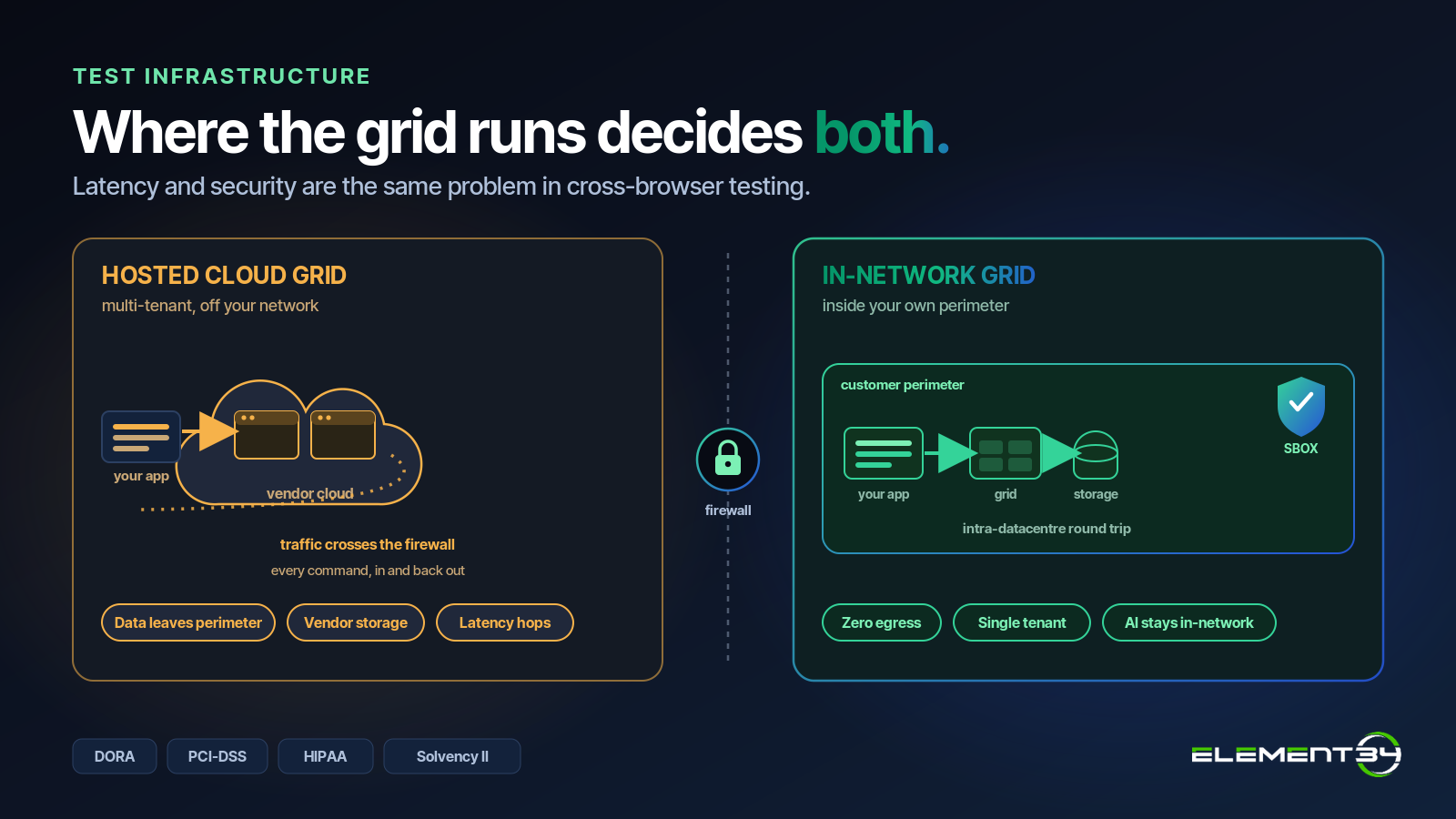
Large enterprises run cross-browser testing at a scale most teams never see: hundreds of parallel browser sessions an hour, millions of tests a year, moving production-shaped data through every run. At that scale, two problems that look separate turn out to be the same problem. Latency and security risk both come down to a single architectural question: where does the test grid actually run?
Most of the advice online treats these as two different checklists. This piece treats them as one, because the fix for both is the same.
Enterprise cross-browser testing moves production-shaped data, real customer records and real session tokens, through hundreds or thousands of parallel browser sessions every hour. Every session that leaves the company firewall to reach a hosted cloud is one latency hop and one compliance surface. The two problems share a single root cause: where the grid runs.
A bank or insurer can run several million browser tests a year across dozens of product teams, each exercising an internal application that holds regulated data. The moment that test executes outside your network, you have taken on both a performance cost (the round trip) and a governance cost (the data crossing a trust boundary). Teams tend to budget for one and discover the other during an audit. For the architecture that avoids both, see the SBOX platform overview.
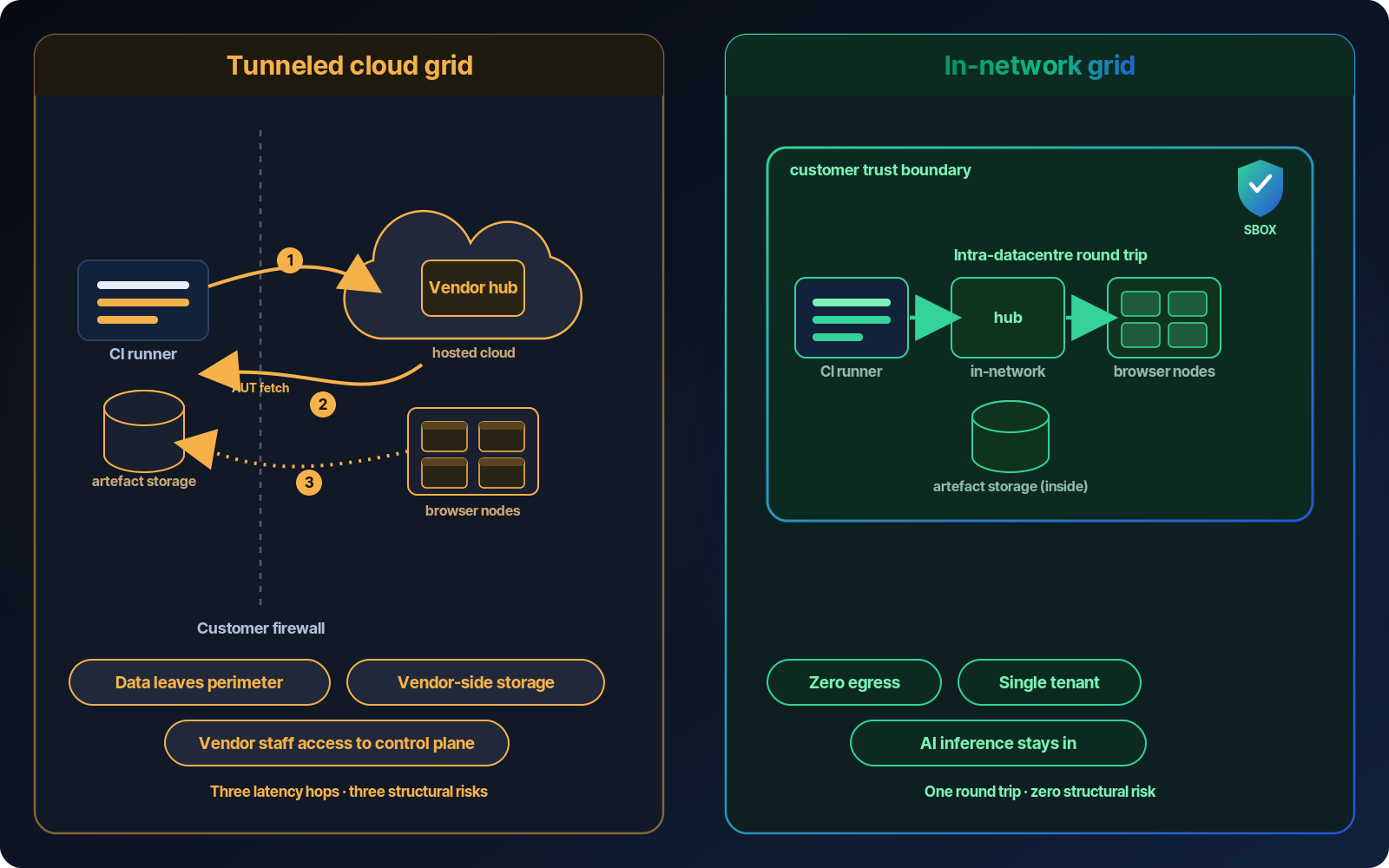
A WebDriver session in a hosted cloud opens an encrypted tunnel from your CI runner to the vendor's hub, routes commands over the public internet to a browser node in the vendor's data centre, pulls your application under test back through that connection, and sends every screenshot, DOM snapshot, and video out of the cloud for storage. The tunnel is encrypted; the trust boundary still gets crossed on every command.
Sauce Labs is a clear example of this model done well: its documentation describes reaching internal applications over a Sauce Connect or IPSec tunnel while the tests themselves run on the Sauce cloud. That is a mature, widely used pattern. It is worth naming the four things that leave your perimeter on any such run: the WebDriver commands, the application responses pulled from your internal app, the session artefacts (screenshots, DOM captures, video), and, where AI features are in play, the inference prompts. Encryption protects those in transit but does not change where they are processed or stored. For the protocol framing, see the W3C WebDriver BiDi specification.
Latency in a tunneled cloud grid is the sum of three hops: CI runner to the vendor hub, vendor hub back through your firewall to the application under test, and vendor hub to artefact storage. Running the grid inside your own network collapses all three to intra-datacentre round trips, typically sub-millisecond per command, versus tens of milliseconds per command across a trans-regional cloud.
Hosted vendors genuinely reduce their own latency with distributed infrastructure, and that is real engineering strength. But it reduces vendor-side latency only. The hop across your firewall to reach the internal application under test remains, and it sits on the critical path of every command. Multiply a small per-command cost by tens of thousands of commands in a daily regression run and it compounds into material cycle-time. An on-premise Selenium grid removes that hop entirely. For reference on sustained in-network throughput, Element34's Private Cloud deployment documents reference configurations of 4 Hubs × 25 Executors handling 15,000 to 50,000 daily executions.
Three security risks are structural to hosted cross-browser testing, test data leaving the perimeter, vendor-side retention of session recordings and screenshots, and vendor staff access to the control plane, and no certification removes them, because they are properties of the deployment model rather than the vendor's security practices. Two further risks, in-transit interception and egress-IP exposure, can be mitigated with tunneling. The structural three cannot.
To be clear and fair: Sauce Labs holds SOC 2 Type 2, ISO 27001, and ISO 27701 certifications across its portfolio, which is a strong security posture. Those certifications demonstrate that Sauce meets a set of controls on its own infrastructure. They do not change where your test data physically sits. The standards framing here is consistent with NIST SP 800-53 Rev. 5 controls on separate, controlled test environments, the PCI SSC guidance on scoping and segmentation, and the third-party risk expectations in the EU Digital Operational Resilience Act (DORA).
A private grid reduces both problems with the same architectural choice: the Selenium, Playwright, and Appium grid, its control plane, its artefact storage, and its AI inference all run inside the customer's own network, single-tenant and air-gap capable. Latency collapses to intra-datacentre round trips. The structural security risks disappear because the data never leaves the perimeter in the first place.
Element34 SBOX offers this in three shapes, with the same controls across all of them: Private Cloud in your own datacentre, Virtual Private Cloud inside your AWS, Azure, or GCP account, and Managed Private Cloud operated for you and pinned to your region. For a side-by-side of the three shapes, see Private Cloud vs VPC vs Managed Private Cloud. For teams specifically evaluating a Sauce Labs alternative that keeps the grid in-network, the full head-to-head sits at SBOX vs Sauce Labs.
This is not theoretical. A European Fortune Global 500 insurer has run its group-wide browser testing, manual and automated, on one shared, single-tenant SBOX instance on its own premises for ten years. In the last twelve months it executed more than four million tests, sustained seventy to ninety parallel executions across the group, and supported more than forty projects on that one shared instance, reducing automation campaigns from several days to a few hours. The full story is in the insurer case study.
Mobile cross-browser testing stays inside the perimeter when the real-device cloud, the Appium hub, and the session artefacts all sit on hardware the customer controls. SBOX Real Device Cloud offers deployment shapes that keep screen recordings, screen captures, and device-side telemetry inside the customer trust boundary, with the device pool wiped between sessions.
Mobile is where hosted architectures leak hardest, because screens and recordings of a banking or health app are exactly the artefacts an auditor cares about. Hosted device fleets are genuinely broader: Sauce Labs publishes a fleet of 7,500+ iOS and Android real devices and 1,700+ emulators and simulators (per saucelabs.com/products/supported-browsers-devices, accessed 6 October 2026), and for consumer-scale device coverage that breadth is a real advantage. The in-network model fits the opposite case, when your reviewer will not accept regulated session data on a device the vendor controls. See the Real Device Cloud for the deployment options.
Keep AI test automation private with bring-your-own-LLM: the test platform calls the model endpoint the customer connects, whether OpenAI, Anthropic, Azure OpenAI, or a self-hosted model, and prompts, completions, DOM snapshots, and failure clusters move only between the private grid and that endpoint. The test vendor never receives test data, screenshots, or application context.
This is a real architectural fork. Sauce Labs' AURA — AI-Unified Release Assurance — is a closed-loop agentic platform that authors, runs, and analyses tests with human oversight, running on Sauce-hosted infrastructure (per saucelabs.com/products, accessed 6 October 2026). SBOX takes the opposite route: Auto Heal resolves many locator changes with a sub-100-millisecond deterministic decision that invokes no model at all, and Automated RCA turns a failed regression into an assigned owner in roughly fifteen minutes rather than hours of manual triage, with inference running against your own model endpoint. For the deeper dive on why the inference endpoint matters, see AI test automation without data egress. That keeps the AI layer out of scope for the vendor and easier to defend in your own AI governance review.
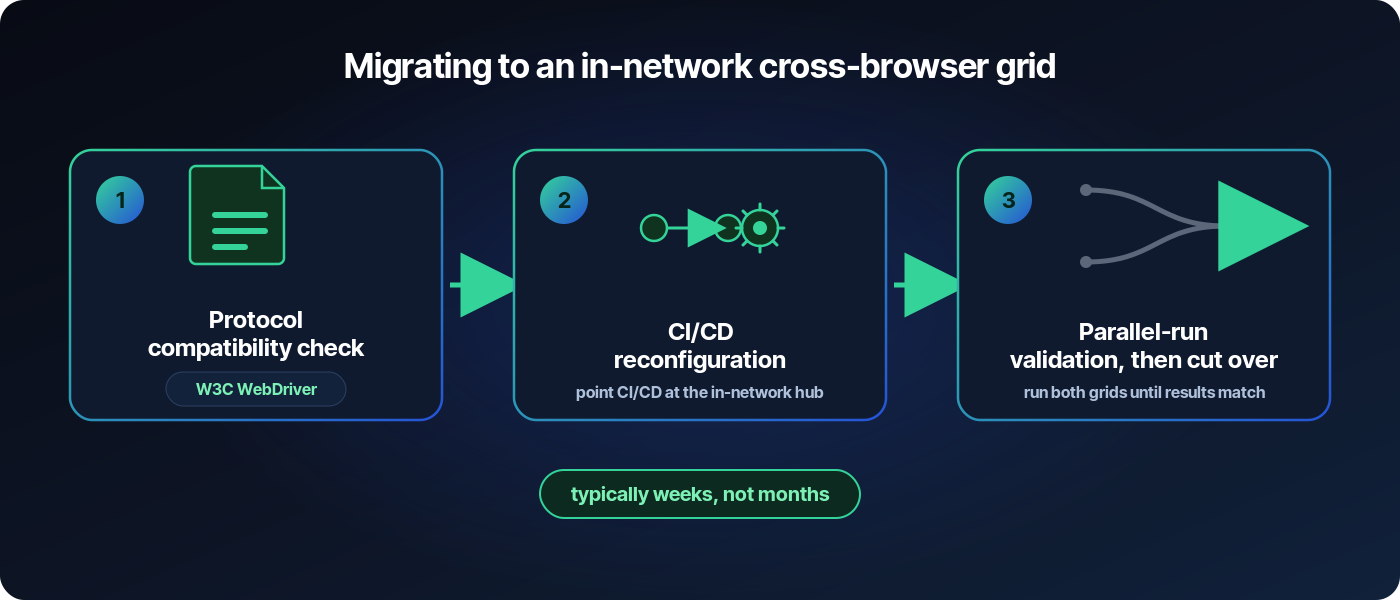
A migration from a tunneled cloud grid to a private in-network grid is a configuration change for test suites already on the W3C WebDriver protocol: swap the session endpoint, swap credentials, point CI/CD at the in-network hub, run a parallel-validation window, and cut over on a defined date. Suites still on the legacy JSON Wire protocol or DesiredCapabilities need a one-time refactor first. For most teams evaluating a Sauce Labs alternative, the migration runs in weeks, not months.
The three steps are a protocol-compatibility check against the W3C WebDriver specification, a CI/CD reconfiguration to point Jenkins, GitLab, GitHub Actions, or Azure DevOps at the in-network hub, and a parallel-run validation window where both grids run side by side until results match. Because the grid runs inside your network, there is no tunnel to stand up or maintain afterwards.
The next step is not a feature demo. It is a short architecture review of where your test data lives today and how many networks it crosses before a test runs. That one diagram usually makes the decision for you.
The Private by Design walkthrough shows a private, AI-native grid running inside a perimeter end to end, and the 56-minute Private by Design webinar covers the architecture in depth. When you are ready to scope your own environment, book a working session. If you are evaluating multiple hosted options alongside Sauce Labs alternatives, we maintain architecture-first comparisons at SBOX vs Sauce Labs and SBOX vs BrowserStack. You can also read how teams in regulated sectors approach this in our pieces on private test automation grids for finance and automotive and self-hosted alternatives for regulated banks.
No. Those certifications demonstrate that the vendor meets a set of security controls on its own infrastructure. They do not change where the test data physically sits. If test traffic crosses your firewall into a hosted cloud, data residency remains a question that only the deployment model answers.
A tunnel like Sauce Connect secures the connection to your internal application under test, and it is a genuine mitigation for in-transit risk. But test commands, screenshots, DOM snapshots, and session recordings still leave your perimeter to be processed and stored in the vendor cloud. The tunnel reduces one risk; it does not eliminate the structural ones.
Intra-datacentre WebDriver round trips typically run sub-millisecond, while trans-regional round trips to a hosted hub typically run tens of milliseconds per command. At tens of thousands of commands per daily run, those small per-command savings compound into material cycle-time compression.
DORA does not mandate a private test grid by name. It requires documented ICT third-party risk, rights of access and audit, exit strategies, and participation in threat-led penetration testing. In-network test infrastructure is materially easier to defend against each of those clauses than a shared vendor cloud, which is why many regulated teams choose it.
Yes. Bring-your-own-LLM configurations let the test platform call your own model endpoint, whether OpenAI, Anthropic, Azure OpenAI, or a self-hosted model. Prompts and completions move only between the private grid and that endpoint, so no third-party test vendor receives your data.
Sauce Labs figures and capabilities are taken from Sauce Labs' published product documentation, accessed 6 October 2026, and are re-verified quarterly by Element34. Where a capability is not shown, that means the vendor does not publicly document it as of the access date, not that it is unavailable. Selenium is a trademark of the Software Freedom Conservancy. Sauce Labs and Sauce are registered trademarks of Sauce Labs Inc. Element34 is not affiliated with, endorsed by, or sponsored by either.