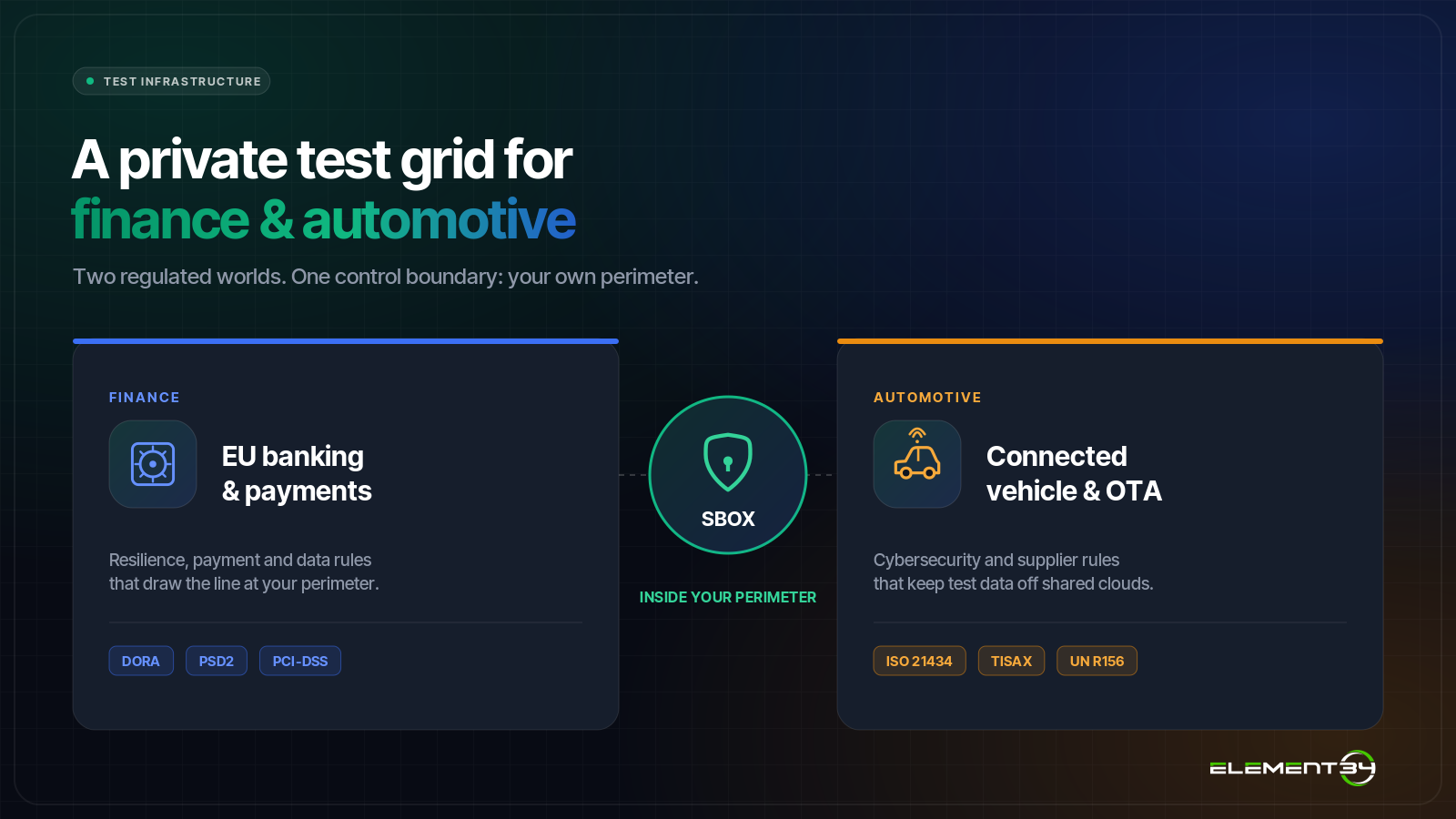
Enterprise test automation at scale produces production-shaped data inside non-production environments. Real customer records for a bank, real vehicle telemetry for an automotive OEM, real payment tokens moving through the test grid every hour of every day. Regulators in both sectors now treat the test perimeter with the same weight as the live one.
For teams who have already ruled out a public SaaS test grid, the next question is which private option fits. Every SBOX customer we work with lands on one of three private deployment models: Private Cloud on customer premises, Virtual Private Cloud inside the customer cloud account, or Managed Private Cloud that Element34 operates in a dedicated single-tenant tenancy. All three keep the test perimeter inside the customer trust boundary. This piece is how we help finance and automotive enterprises choose.
A private test automation grid is a Selenium, Playwright, or Appium test grid where compute, storage, and network sit inside one organisation's compliance perimeter and are dedicated to that organisation alone. No test data, session recordings, or artefacts cross the firewall to a shared multi-tenant vendor. That definition is what separates a private test grid from a public SaaS grid, and it is what makes the private option viable for regulated finance and automotive workloads.
The regulatory clauses that push finance and automotive enterprises toward private test infrastructure map cleanly onto specific test-environment obligations.
Sending test data carrying real banking transactions or connected-vehicle telemetry through a shared public SaaS grid opens a new compliance surface every quarter. One European Fortune Global 500 insurer we work with runs 4 million-plus Selenium and Playwright tests a year on a single-tenant private cloud grid on its own premises, aligned by architecture with DORA Article 30 and Solvency II Article 41.
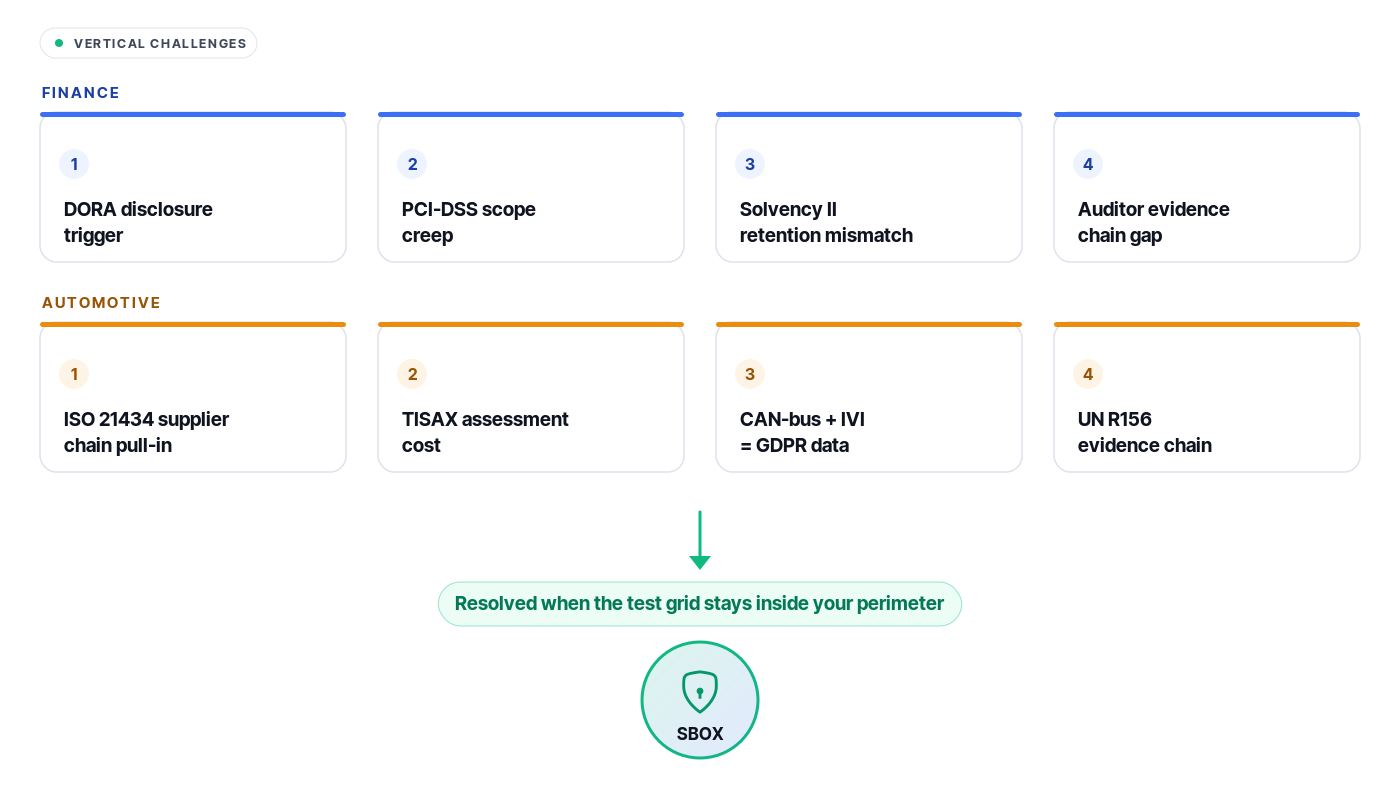
Finance teams running public SaaS grids hit four recurring problems. Test data carrying customer records or cardholder tokens leaves the bank perimeter, which triggers DORA Article 30 ICT third-party risk disclosure and expands PCI-DSS scope every quarter. Session recordings and screenshots sit on the vendor's infrastructure under the vendor's retention policy, not the seven-year record-keeping timeline that Solvency II Article 41 requires from insurers. Cross-border test data flow needs GDPR Chapter V evidence for every SaaS deployment. And when the auditor arrives, the bank owns the compliance evidence chain but not the infrastructure that produced it.
Automotive OEMs and Tier-1 suppliers face a parallel set. Public SaaS test grids become ICT suppliers under ISO/SAE 21434, pulling the vendor into the OEM's cybersecurity management system with the assessment and audit obligations that carries. TISAX supplier-tier assessments run fifteen to fifty thousand euros per vendor tier. Connected-vehicle telemetry captured in test sessions frequently contains personal data under GDPR the moment CAN-bus data or infotainment interactions are recorded. And UN R156 requires an immutable evidence chain for software updates that most SaaS retention policies do not support.
Public SaaS grids market a 'private cloud' or 'dedicated' tier as their answer. In practice, the tier means a dedicated tenant on the vendor's multi-tenant infrastructure, with the vendor's control plane, the vendor's staff with access, and the vendor's data-processing agreement still governing session recordings, screenshots, and DOM captures. None of the vertical challenges above actually resolve, because the underlying data still crosses the bank or OEM firewall. It is dedicated compute, not a private perimeter.
A true private test automation grid inverts that. Compute runs on customer-controlled infrastructure or inside the customer cloud tenancy. Session recordings, screenshots, and audit logs stay inside the customer trust boundary and under the customer's retention timeline. No vendor staff has standing access. That inversion is what makes the grid viable for a DORA critical-ICT designation, an ISO 21434 supplier audit, a TISAX assessment, and a PSD2 scoping conversation.
See how SBOX resolves each of these in practice. Download the Private by Design deployment guide for the DORA and ISO 21434 alignment checklist we use with regulated finance and automotive customers.
SBOX is a test automation platform that deploys in three shapes to fit different regulatory postures: Private Cloud on customer premises, Virtual Private Cloud inside your AWS, Azure, or GCP account, and Managed Private Cloud that Element34 operates in a dedicated single-tenant region on your behalf. Full side-by-side detail on the deployment comparison page and in our Private Cloud vs VPC vs Managed Private Cloud deep dive.
In every model, Selenium, Playwright, and Appium execution stays inside the customer perimeter. Session recordings and audit logs are written to the customer SIEM. When SBOX AI features are used, test authoring runs on an air-gapped LLM inside the customer perimeter. Self-healing selectors and root-cause analysis run inference on the customer's own model endpoint under a BYO-LLM configuration. Prompts and completions stay inside the customer trust boundary in every deployment. That is how a private test grid can be AI-native without becoming a data-egress problem.
The strongest objection to any private test automation grid is maintenance cost. Selectors drift when the application under test changes. Failed sessions need triage. Both are expensive when a team is running millions of tests a quarter. A bank running four million tests a year cannot afford a dedicated triage headcount, and an automotive Tier-1 supplier under TISAX cannot afford selectors that break audit evidence.
SBOX addresses both inside the private perimeter. Auto Heal repairs drifted locators at runtime, so a UI change does not produce a wave of red sessions the next morning. Automated RCA clusters failed sessions, attributes the cause, and proposes the fix in plain English. Both run on the customer's own LLM endpoint. Neither sends the DOM or screenshots to a vendor cloud. The maintenance reduction is real, and it lands inside the customer trust boundary rather than outside it.
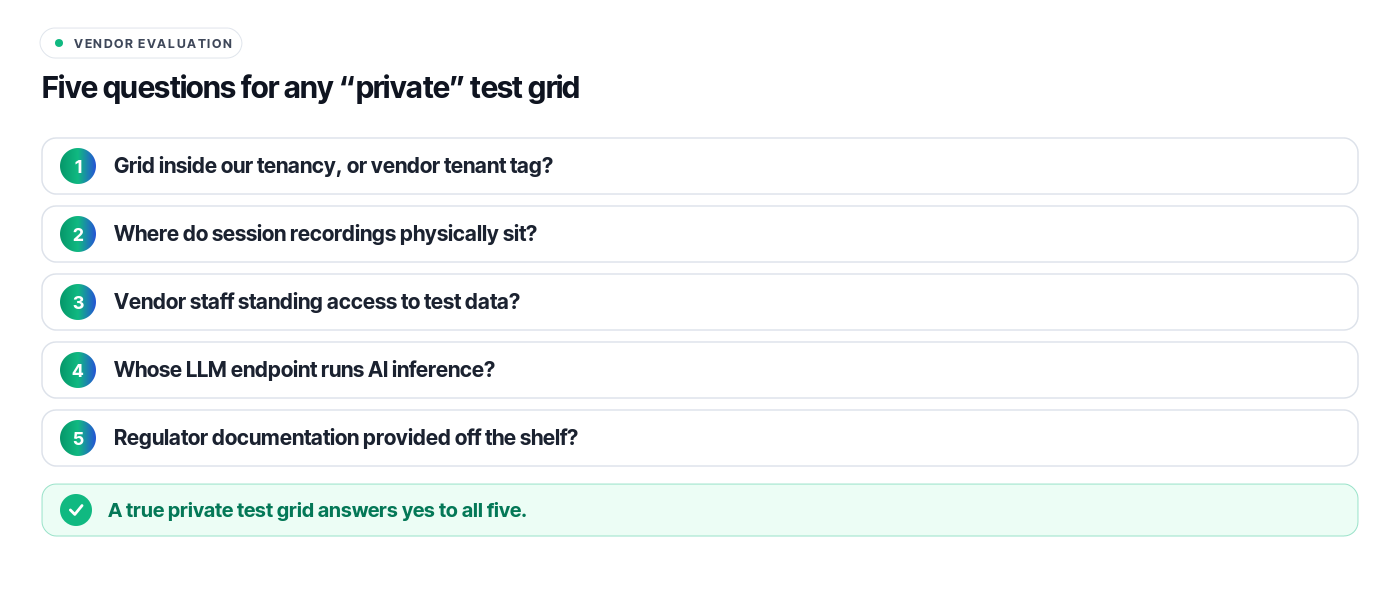
The five questions worth asking before signing:
Public SaaS vendors typically pass on Q1 and struggle on Q4. A true private grid answers all five in the same conversation.
Watch the Private by Design webinar. A 45-minute walkthrough of a live SBOX deployment migration inside a regulated enterprise. Access the on-demand webinar.
Or, if you would rather map the three private tiers onto your specific regulatory posture in a working session, book a one-hour session with our team.
Prefer to see how this works at enterprise scale first? Read the full case study of a European Fortune Global 500 insurer running 4 million-plus Selenium and Playwright tests a year on a private test grid inside its own premises.
A private test automation grid runs on infrastructure dedicated to one organisation inside that organisation's compliance perimeter. A public SaaS grid runs on multi-tenant vendor infrastructure with test data crossing the vendor firewall. The distinction determines which regulations you can align with by architecture.
On-premise is one shape of private test grid. Private also covers a Virtual Private Cloud inside your own AWS or Azure account, and a Managed Private Cloud that a vendor operates in a dedicated single-tenant region. All three keep the test grid perimeter inside the customer trust boundary.
DORA Article 30, Solvency II Article 41, PSD2, and PCI-DSS v4.0 all reach into the test environment when it processes production-shaped data. None of them mandate 'private grid' by name, but each becomes materially easier to align with when the test perimeter is not shared with other tenants.
ISO/SAE 21434 requires cybersecurity management across the vehicle lifecycle, including validation environments. In practice, OEMs and Tier-1 suppliers evidencing this to auditors find a private validation grid materially simpler to defend than a shared public grid, particularly under UN R155 and TISAX overlays.
Yes. SBOX AI features run inference on the customer's own LLM endpoint under a BYO-LLM configuration. Prompts and completions stay inside the customer trust boundary in every deployment model.