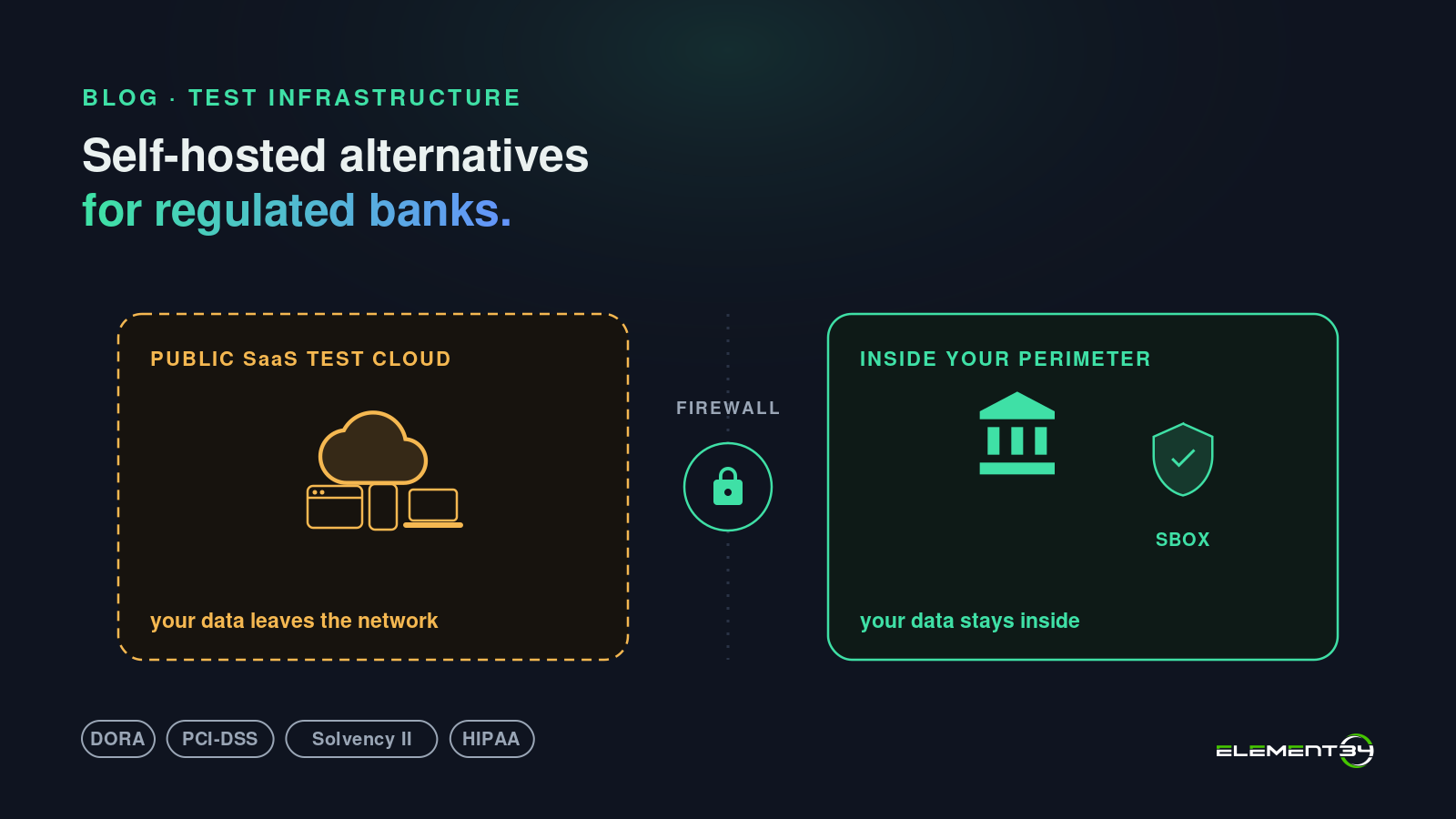
Test automation at a regulated bank produces production-shaped data every working hour. Real customer records, real payment tokens, real mobile-banking session flows move through the browser and device test grid. Regulators now treat that test perimeter with the same weight as the live one. DORA pulls the test grid into the bank's ICT third-party risk register. PSD2 and PCI-DSS scope expands every quarter cardholder data crosses into a shared vendor environment. HIPAA and Solvency II carry parallel obligations for insurers and healthcare payers on the same infrastructure.
For a bank whose CISO has read those obligations in the same week, the shortlist question stops being 'which public SaaS test grid is fastest' and becomes 'which self-hosted BrowserStack alternative actually keeps our test data inside our perimeter.' This piece is how we help regulated banks and other enterprises answer it honestly, architecture-first. Full detail on the platform: SBOX.
A self-hosted test grid is a Selenium, Playwright, or Appium execution environment where compute, storage, network, and control plane sit inside the customer's own network, behind the customer's firewall. No test data, session recordings, screenshots, or DOM captures cross the firewall to a shared multi-tenant vendor.
The phrase 'self-hosted' sits on a spectrum. BrowserStack documents Automate Self-Hosted, which the customer deploys on their own AWS, Azure, or GCP account. Sauce Labs documents Sauce Connect for reaching internal apps behind the firewall while tests run on Sauce-operated infrastructure, plus dedicated Private Devices and a single-tenant Private Cloud for its app-distribution product. TestMu AI (formerly LambdaTest) documents a Private Real Device Cloud behind the firewall and an on-premise Selenium grid for CI/CD. Each of these is a different point on the 'how much of the stack sits inside your network' spectrum. This piece is about the end of that spectrum where the whole grid, its control plane, and its AI inference all run inside the bank's perimeter.
Eight criteria a security-minded engineering leader actually evaluates on.
| Criterion | Why it matters to a bank |
|---|---|
| Default operating model | Whether tests run on vendor-operated infrastructure or inside the bank's own network |
| Where test data lives | Direct auditor evidence for DORA and PCI-DSS scope containment |
| Who operates the grid | Vendor operational access vs bank-controlled perimeter |
| On-prem and air-gap support | Ability to deploy without any outbound vendor callback |
| AI and data handling | Whether AI features process prompts and test data inside or outside the perimeter |
| Framework support | Selenium, Playwright, Appium coverage for web and mobile |
| Real device coverage | Whether iOS and Android testing runs on customer-controlled devices |
| Cost model | Predictable annual license vs metered SaaS |
The first five are where self-hosted alternatives materially differ from public SaaS grids for regulated enterprise test automation.
Yes, in a specific shape. BrowserStack is a mature, feature-rich testing cloud with one of the largest device and browser matrices in the market. Its published documentation lists 3,500+ browser-OS combinations and 30,000+ real devices (accessed 25 September 2026). Alongside the multi-tenant public cloud, BrowserStack documents Automate Self-Hosted, a self-hosted grid the customer deploys on their own AWS, Azure, or GCP account.
For a bank whose auditor requires the compute layer to sit inside the customer cloud tenancy, Automate Self-Hosted is a genuine option and worth evaluating on its own terms. Where the pattern differs from a fully in-network alternative is on three points. Mobile testing on real iOS and Android continues to run on BrowserStack's device fleet by default rather than on customer-controlled devices. The AI-agent suite runs in the vendor cloud. And the customer's own team stands up and operates the self-hosted grid rather than a vendor-managed layer running inside the customer perimeter.
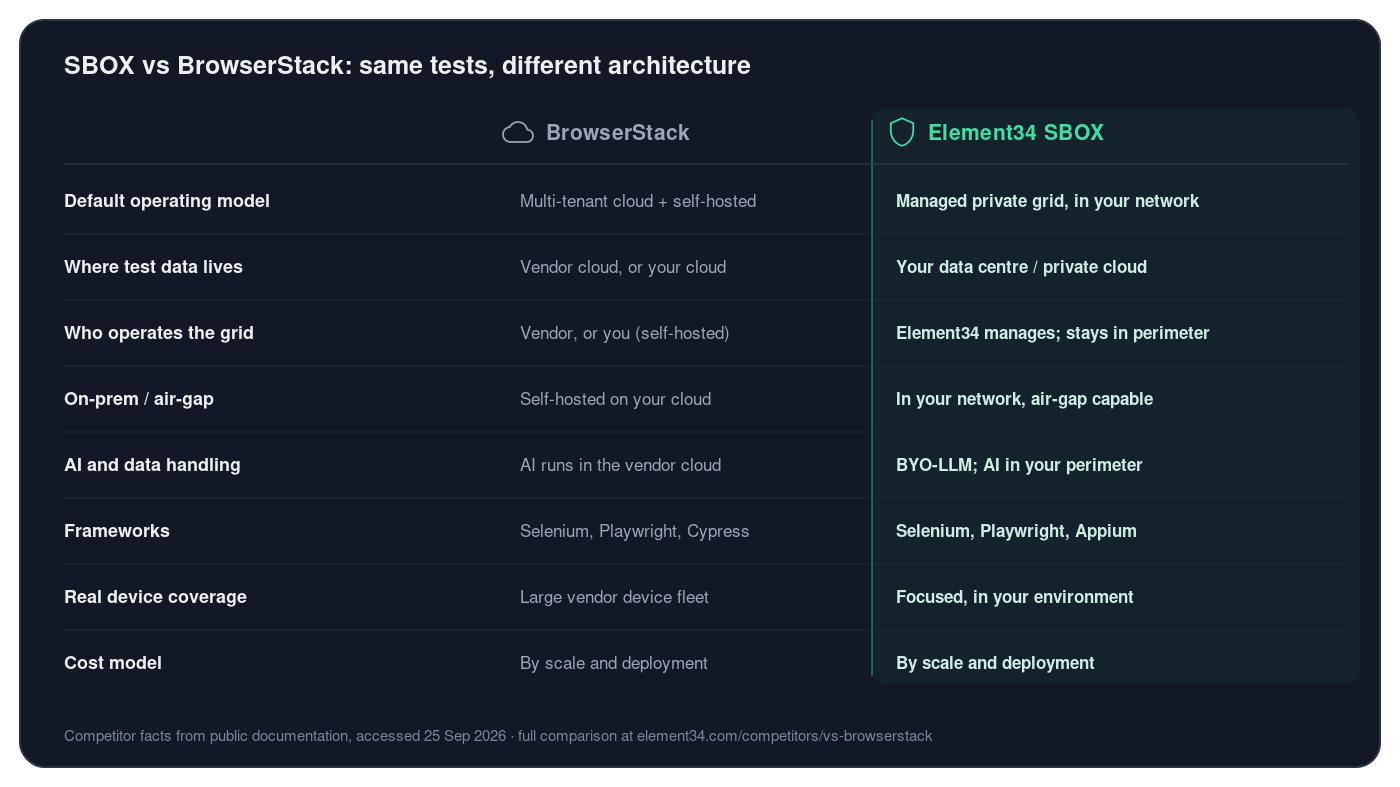
Direct SBOX vs BrowserStack comparison on the criteria from Section 3. Every competitor value below is drawn from BrowserStack's own published documentation.
| Criterion | BrowserStack | Element34 SBOX |
|---|---|---|
| Default operating model | Multi-tenant public cloud plus Automate Self-Hosted on your AWS, Azure, or GCP | Managed private grid running inside your own network |
| Where test data lives | BrowserStack cloud, or your public-cloud account with self-hosted | Your data centre or private cloud, air-gapped supported |
| Who operates the grid | Vendor operates cloud; your team operates self-hosted | Element34 operates the managed layer; grid stays inside your perimeter |
| On-prem and air-gap | Automate Self-Hosted on customer cloud account | Runs inside your network, air-gap capable; no callback to Element34 after initial image pull |
| AI and data handling | Broad AI-agent suite in vendor cloud | Bring-your-own-LLM; AI inference stays in your perimeter |
| Frameworks | Selenium, Playwright, Cypress | Selenium, Playwright, Appium in parallel on the same grid |
| Real device coverage | 30,000+ devices on vendor fleet | Focused matrix inside your controlled environment |
| Cost model | Quoted through sales by scale and deployment | Quoted through sales by scale and deployment |
Full head-to-head on the dedicated comparison page: SBOX vs BrowserStack. Selenium, Playwright, and Appium execution stays inside the customer perimeter in every SBOX deployment. When SBOX AI features are used, test authoring runs on an air-gapped LLM inside the customer perimeter. Auto Heal repairs drifted locators at runtime, and Automated RCA clusters failed sessions and proposes the fix in plain English. Both run inference on the bank's own LLM endpoint. By design, no vendor telemetry or callback exists after the initial container image pull.
See how SBOX resolves this in practice. Download the Private by Design deployment guide for the DORA and PCI-DSS alignment checklist we use with regulated banking customers.
Mobile testing behind firewall is where self-hosted architectures diverge most from public SaaS grids. BrowserStack's 30,000+ real devices, along with Sauce Labs' 7,500+ real devices and TestMu AI's 10,000+ (all accessed 25 September 2026), run on vendor-hosted device fleets. For consumer-facing web and mobile testing across geographies, that breadth is a genuine advantage.
For a bank whose auditor will not accept mobile-banking session data leaving the perimeter, the trade-off is different. SBOX Real Device Cloud provides a focused browser and real-device matrix that runs inside the customer's controlled environment. Real iOS and Android testing for the bank's mobile-banking app runs on hardware inside the bank perimeter, with session data, screen recordings, and Appium telemetry staying inside the customer trust boundary. This is the SBOX design choice: a smaller device matrix in return for architectural certainty that test data does not leave the network.
SBOX is designed as a private, customer-controlled deployment that runs within the customer's own network, behind the customer's firewall. Customer test traffic, application data, credentials, and execution data do not need to be transmitted outside the customer's network. Network access to SBOX is controlled by the customer's own firewall and network policies, including explicit port whitelisting. Element34 does not have inherent or default access to customer SBOX infrastructure, machines, network, test environments, or test data; any access provided to Element34, if required, is controlled and authorised by the customer.
This architecture can support customers operating under regulatory and security frameworks. Framework-specific detail:
DORA (Digital Operational Resilience Act). SBOX can be deployed within the customer's private network or VPC and behind the customer's firewall, and this architecture can support organisations implementing DORA-related requirements around ICT risk management, operational resilience, access control, and protection of information assets. Compliance with DORA remains dependent on the customer's overall controls and operating processes.
HIPAA. SBOX is designed to operate entirely within the customer's controlled environment, and this architecture can support deployments where customers need to maintain control over potentially sensitive or regulated data. Deployment of SBOX alone does not constitute HIPAA compliance; customers remain responsible for their HIPAA administrative, physical, and technical safeguards and for determining whether any additional contractual requirements, such as a BAA, apply to their specific deployment.
PCI-DSS. SBOX can be deployed entirely within the customer's private network and isolated from external networks according to the customer's security architecture. This architecture can support organisations that need to maintain segmentation and control over systems involved in PCI-DSS environments. SBOX itself should not be interpreted as making the customer's environment PCI-DSS compliant; the customer remains responsible for the applicable PCI-DSS controls.
Solvency II. SBOX can operate within the customer's private infrastructure, with no requirement for customer application or test traffic or data to leave the customer's controlled network. This deployment model can support organisations subject to Solvency II requirements relating to ICT controls, operational resilience, security, data protection, and governance. Solvency II compliance remains an organisational responsibility and depends on the customer's broader technology, governance, risk-management, and operational controls.
Most migrations from BrowserStack to a self-hosted alternative are a configuration change, not a rewrite. Three steps.
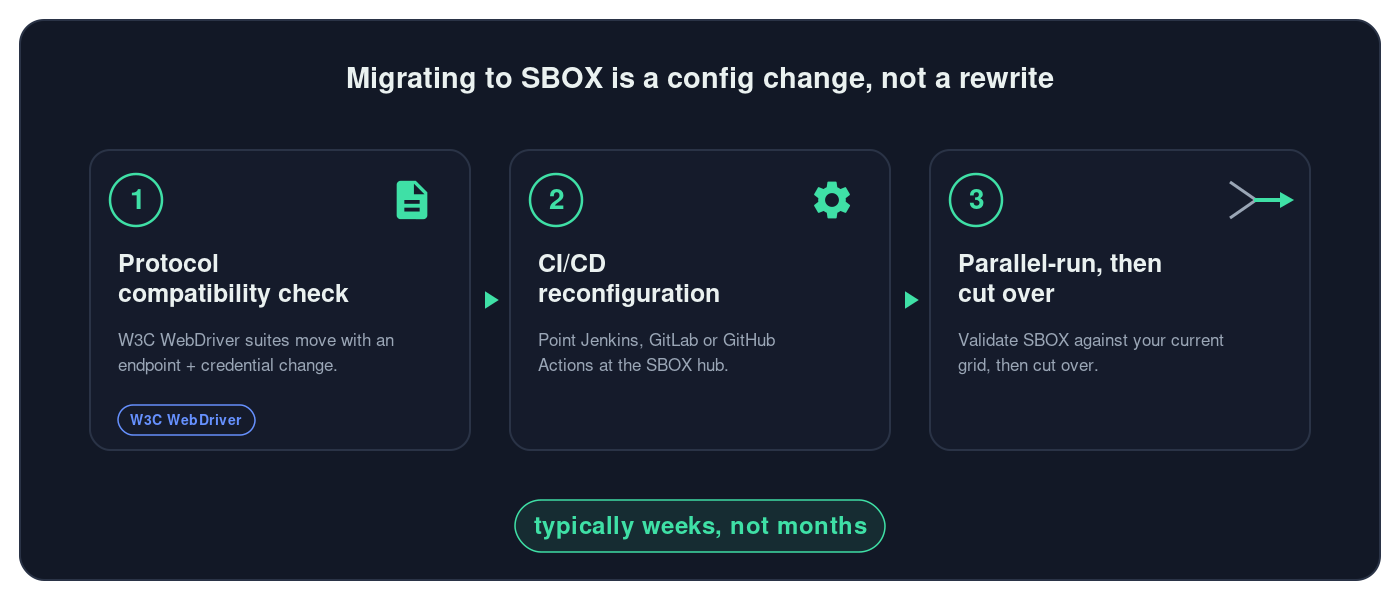
For a bank that has already ruled out a public SaaS test grid, the migration typically takes weeks, not months. A European Fortune Global 500 insurer we work with runs 4 million-plus Selenium and Playwright tests a year on a single-tenant Private Cloud SBOX instance following this exact pattern.
Watch the Private by Design webinar. A 56-minute walkthrough of a live SBOX deployment migration inside a regulated bank. Access the on-demand webinar.
Or, if you would rather map SBOX onto your specific regulatory posture in a working session, book a one-hour session with our team.
Prefer to see how this works at enterprise scale first? Read the full case study of a European Fortune Global 500 insurer running 4 million-plus Selenium and Playwright tests a year on a self-hosted SBOX inside its own premises.
Evaluating other public SaaS grids too? We maintain dedicated architecture-first comparison pages for SBOX vs Sauce Labs and SBOX vs TestMu AI (LambdaTest).
Test suites already on the W3C WebDriver protocol typically move with a session-endpoint and credential change. Suites on the legacy JSON Wire Protocol or DesiredCapabilities need refactoring first, and that timeline depends on suite size.
Yes. SBOX Real Device Cloud runs real devices inside the customer's controlled environment. Session data, screen recordings, and Appium telemetry stay inside the customer trust boundary.
Yes. By design, after the initial container image pull SBOX requires no external connectivity and makes no callback to Element34, so test data, sessions, and logs stay inside the customer environment.
No. SBOX is bring-your-own-LLM and runs AI inference inside the customer perimeter. Prompts and test data move only between SBOX and the LLM endpoint the customer connects. Element34 does not receive them.
SBOX is designed so a customer deployment can meet the controls DORA, HIPAA, PCI-DSS, and Solvency II require. SBOX is not FedRAMP authorised and is not on the FedRAMP Marketplace; where FedRAMP applies, SBOX runs inside the customer's own authorisation boundary. Certification applies to a specific environment, and each customer completes its own audit.