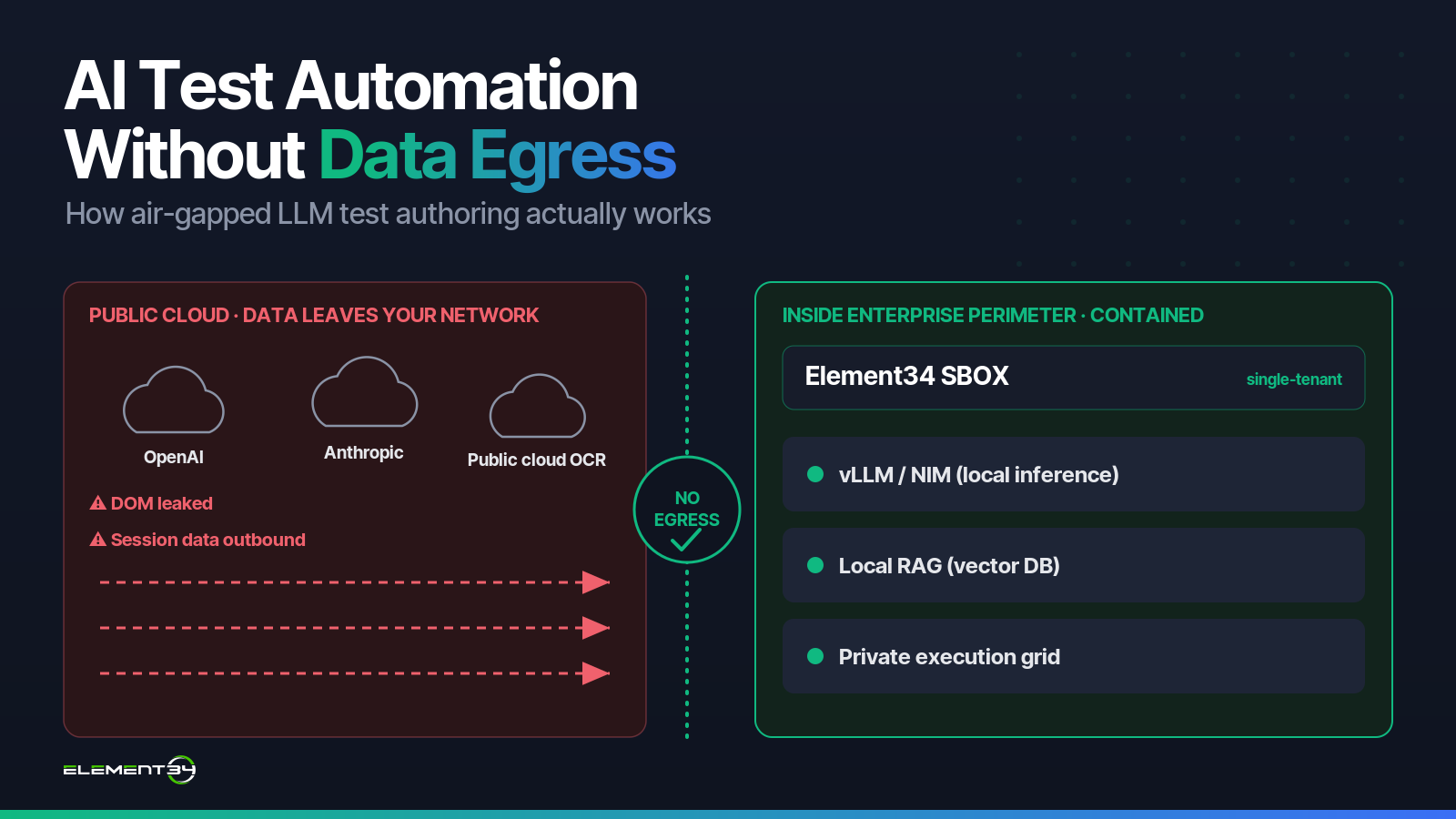
Public AI is a non-starter for regulated QA teams because the speed gains from public LLMs come bundled with data exposure risks that HIPAA, GDPR, DORA, PCI-DSS, and FedRAMP frameworks do not permit.
Every time a QA engineer pastes a user story into a public LLM or lets an AI co-pilot observe a browser session, something significant travels outbound. Traditional AI tools send DOM trees, application screenshots, and metadata to third-party APIs — a direct violation of compliance standards like HIPAA and GDPR. This is the hidden cost of what practitioners call "shadow data": sensitive system information leaving the perimeter through channels that never appear on a data flow diagram.
DOM trees and UI metadata are not just technical artifacts. They expose field names, API endpoint patterns, workflow logic, and application architecture. For a fintech platform or a healthcare portal, that structure represents protectable intellectual property. And because test environments often mirror production, the data risk is not theoretical — it is immediate.
The conflict with SOC 2, GDPR, and DORA becomes acute when you factor in third-party LLM training policies. Many public API providers reserve the right to use submitted inputs for model improvement, meaning proprietary workflows could inform a competitor's AI tool. Self-hosted QA platforms address this directly by keeping inference entirely on-premises.
This is precisely why ai test automation without data egress has shifted from a niche requirement to a baseline expectation in regulated industries moving test automation back behind the firewall. The next logical question is what the internal architecture of such a system actually looks like — and that starts with replacing public inference endpoints with something far more controllable.
AI test automation without data egress is architected by relocating the intelligence layer entirely inside the enterprise perimeter, so regulated QA teams do not have to choose between AI capability and data containment.
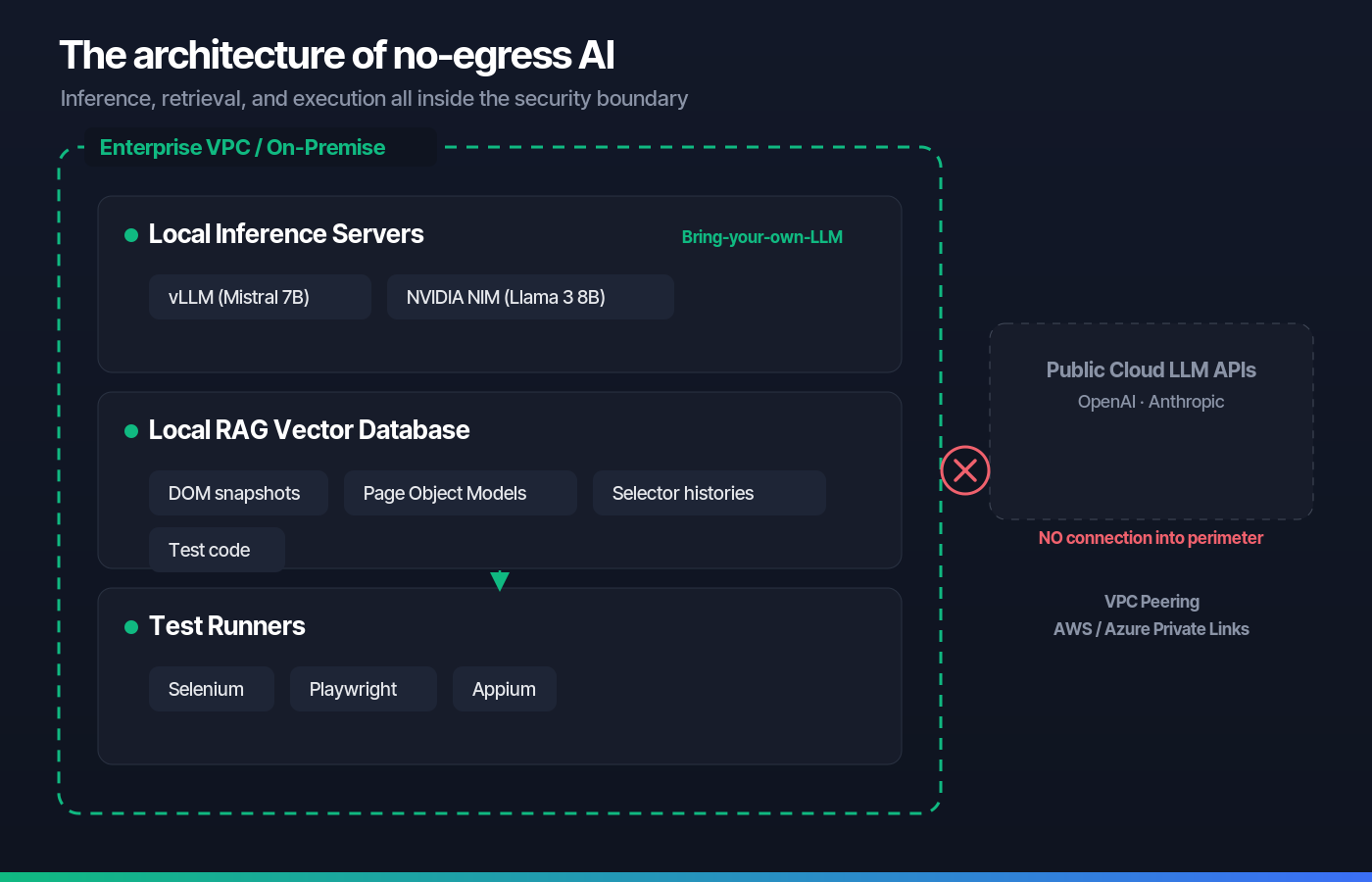
The shift begins by replacing external API calls to cloud-hosted model providers with local inference servers. Tools like vLLM and NVIDIA NIM run directly on on-premise hardware or within a private cloud VPC, serving model completions without a single token leaving the network boundary. Every request for a private LLM for test case generation stays internal — the model receives your application schema, generates the test logic, and returns structured output, all within a closed loop you control.
Smaller models are often more effective than large ones for this use case. Research into model architecture confirms that Small Language Models (SLMs) like Mistral 7B or Llama 3 (8B) perform reliably on structured, bounded tasks such as code generation and UI element identification. These models require significantly less GPU memory than their 70B-parameter counterparts, making on-premise deployment practical for most enterprise hardware configurations. And because QA code generation is a narrow, repetitive task rather than open-ended reasoning, a well-prompted 7B model tends to work better than an over-engineered one.
Network architecture enforces the boundary. VPC Peering and AWS/Azure Private Links ensure that traffic between your test runners, inference servers, and artifact stores never traverses the public internet. The result is a fully air-gapped pipeline — one where the compliance guarantees described in the previous section are enforced at the network layer, not just at the policy layer.
The remaining question is how these local models actually "see" your application under test — which is where local context injection becomes essential.
A private LLM understands your application without external data access — the exact pattern used by Element34 Studio — by building context locally, using a private vector database of your DOM snapshots, Page Object Models, and existing test code, so no byte ever crosses the perimeter.
Retrieval-Augmented Generation (RAG) is a technique that lets an AI model answer questions using a specific document library instead of its general training data. In QA testing, that library becomes your application's own DOM structure, test history, and Page Object Models — grounding every generated test in patterns the model has already seen in your codebase.
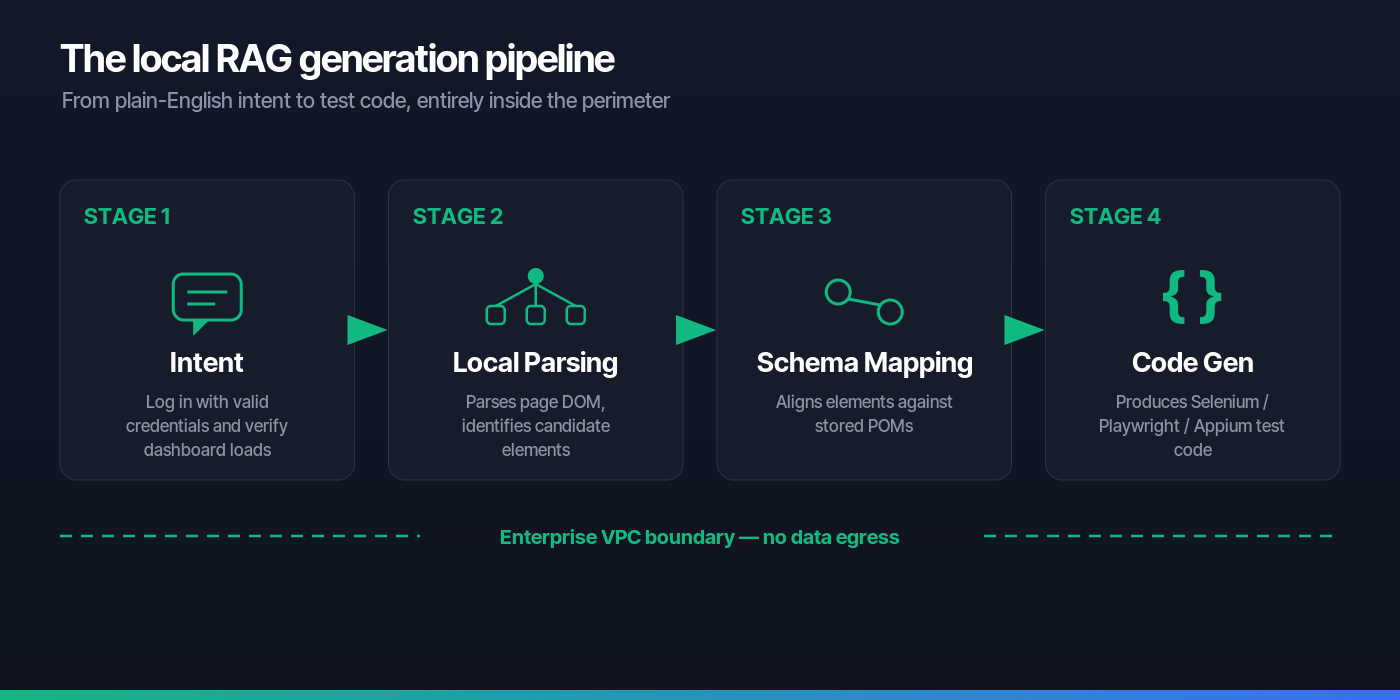
The foundation of that understanding is a local vector database. DOM snapshots, Page Object Models, selector histories, and existing test code are embedded and stored inside the VPC, giving the model a continuously updated map of the application. Storing these patterns in a local vector database ensures data never leaves the network — a non-negotiable requirement in regulated environments.
The generation workflow follows a clean four-stage pipeline: a tester expresses intent in plain language, a local parser breaks down the DOM to identify candidate elements, a schema mapping layer aligns those elements against stored POMs, and the model produces test code grounded in patterns it has already seen in your codebase. Each stage operates entirely within the boundary established in the previous section.
Speed is a practical benefit, not just a compliance one. Local RAG retrieval eliminates the round-trip latency of cloud API calls. Element identification happens in milliseconds against an indexed local store rather than waiting on an external endpoint. In practice, this tends to produce tighter feedback loops during active test authoring sessions — engineers are not waiting on network calls each time context needs to be refreshed.
That same local model architecture, however, has historically struggled with one category of inputs: visual UI elements that exist only as rendered pixels rather than queryable DOM nodes. The next section examines how vision-language models are solving exactly that problem — entirely on-device.
Vision-language models can replace public OCR services for UI testing by processing screenshots on local GPUs inside the customer data center, eliminating the compliance risk that came from every screenshot being sent to a cloud OCR endpoint. In an air-gapped AI test automation architecture, that risk disappears entirely because the vision model never leaves the network perimeter.
The shift is made practical by compact Vision-Language Models (VLMs) such as Moondream and LLaVA, which run directly on local GPUs within your data center. Rather than uploading a screenshot to a third-party API and waiting for a text response, these models process the image on-device and return UI element coordinates immediately. The model sees a button, a form field, or a balance summary — and outputs its position — without that frame ever crossing an organizational boundary.
On-device vision identifies UI elements via coordinates, not cloud round-trips. This is a meaningful architectural distinction. A financial dashboard containing account numbers, portfolio values, or customer identifiers can be interrogated for testable elements without any pixel of that data touching an external server. The Research Insight on On-Device Vision confirms that models like Moondream operate precisely this way — resolving elements through coordinate mapping rather than forwarding raw image data outward.
For regulated QA teams handling sensitive financial or healthcare interfaces, this capability closes what was previously an uncomfortable gap. The LLM generating test scripts was contained; the vision layer was not. Local VLMs unify both layers under the same security posture. Of course, the generated scripts still need somewhere to execute — and that execution environment carries its own set of containment requirements worth examining closely.
Private AI test authoring requires a private execution grid because a private LLM that generates test scripts is only half a solution — if those scripts execute on a public cloud grid, your enterprise AI testing data privacy compliance posture collapses at the finish line.
The generation layer and the execution layer must share the same security boundary. This is the "leaky grid" problem: organizations invest heavily in on-premise model inference, then route test runs through external browser farms where session data, DOM snapshots, and network payloads cross public infrastructure. Every test execution becomes a potential data egress event, no different from sending screenshots to a cloud OCR endpoint.
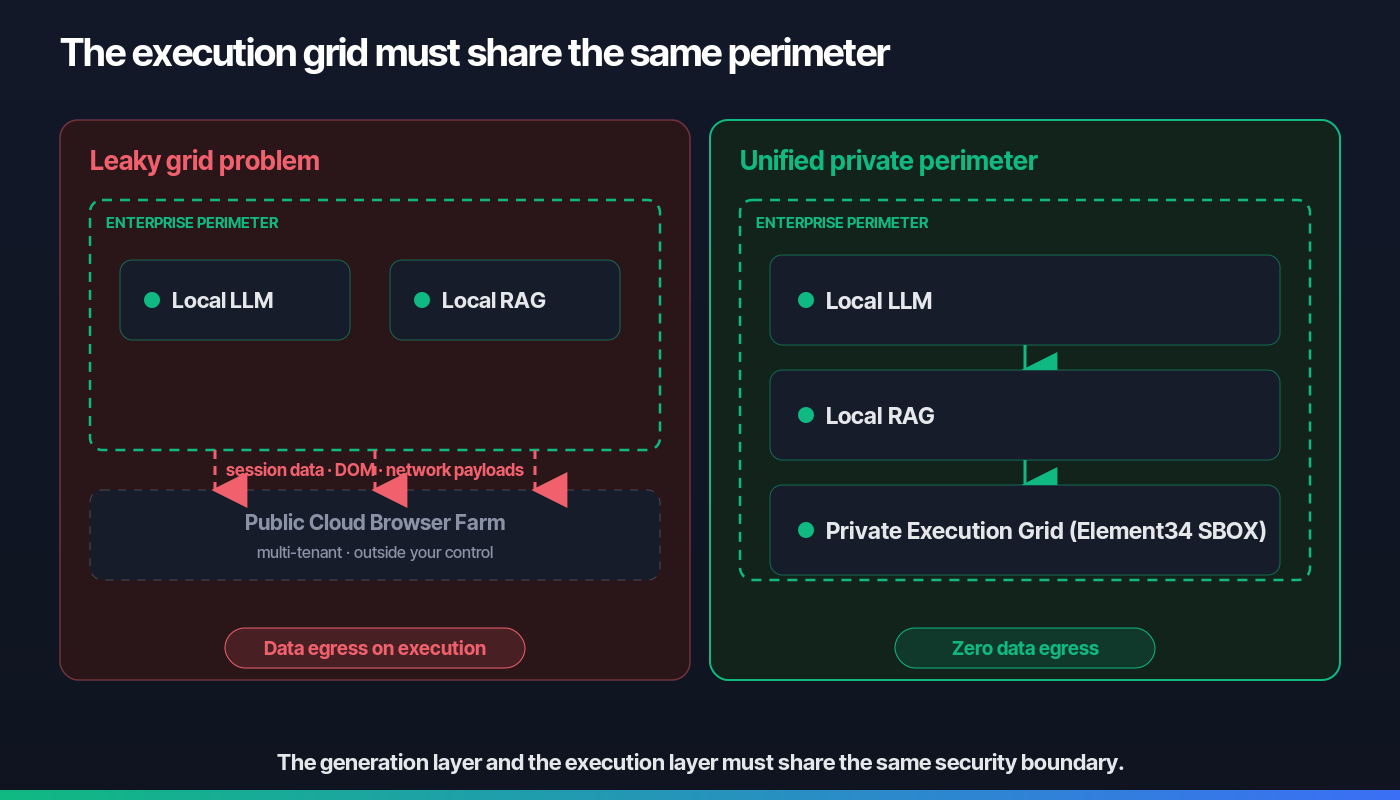
The fix is centralizing the entire CI/CD execution chain within the corporate network. When your pipeline triggers a test run, the browser instances, the grid router, and the results storage all need to live inside the same perimeter as your LLM and your RAG index. That alignment eliminates the gap where regulated data can escape — and it makes audit trails far easier to produce during a compliance review.
Element34 SBOX addresses exactly this infrastructure requirement by enabling enterprises to execute cross-browser tests 100% inside their own network, with no latency penalties and no egress. AI-generated scripts produced by a local model can run directly against SBOX browser instances, keeping the full test lifecycle — authoring, execution, and reporting — behind the firewall. That closed loop is what transforms a promising AI pilot into a production-ready, audit-safe workflow.
Understanding the complete stack — local inference, private RAG, and a secure execution grid — sets the stage for evaluating what a mature private AI QA program actually costs and delivers.
Regulated QA teams should know that private AI test automation is not a feature upgrade — it is a foundational infrastructure shift, and data egress remains the single greatest blocker preventing regulated teams from adopting AI-assisted testing at scale.
For organizations pursuing secure AI software testing for finance, healthcare, or defense, the architecture cannot be optional. What the previous sections have established converges into a clear framework: effective private AI QA depends on three pillars working in concert. Local inference keeps model processing on hardware you control. Retrieval-Augmented Generation (RAG) grounds every generated test in your actual codebase and compliance documentation, rather than generic training data. Private execution grids ensure that scripts never leave your perimeter at runtime. Remove any one pillar, and the compliance guarantee collapses.
The performance trade-off that once made this conversation difficult is narrowing fast. Smaller language models — purpose-tuned for structured output — now deliver comparable accuracy to much larger models for test generation tasks, often with lower latency and significantly reduced hardware overhead. Private LLM test authoring is best understood as a transition from AI as a Service to AI as Infrastructure — a distinction that matters enormously when a single audit finding can halt a product release.
The practical implication is straightforward. Security-first AI testing is a capital investment, not a recurring subscription — and the teams that treat it as infrastructure now will be far better positioned as regulatory scrutiny around AI data handling intensifies. The next question, then, is not whether your organization should move in this direction. It is whether your current QA pipeline already has data egress points you have not yet mapped.
Enterprises secure AI test automation as autonomous testing scales by treating the QA infrastructure — inference, context storage, and execution — as a single containment boundary, rather than relying on vendor privacy promises. The shift underway is fundamental: QA engineers are moving from manually authoring test scripts to guiding local AI agents that generate, iterate, and validate tests autonomously. That guidance role requires far less line-by-line coding and far more architectural judgment about what the agent can access, where outputs land, and how execution stays within a compliant boundary.
Waiting for public API providers to offer "enterprise-grade" privacy controls is a losing strategy. Regulatory deadlines, audit cycles, and breach liability do not pause while vendors iterate on their data handling policies. In practice, the teams that delay air-gapped adoption are the ones left retrofitting compliance controls onto a pipeline that was never designed for them — a significantly more costly problem than building the boundary correctly from the start.
The most actionable next step is an egress audit. Map every point in your current QA pipeline where test data, application state, or user-identifying information touches an external network call — including logging services, CI integrations, and any cloud-hosted model endpoint.
Element34 addresses exactly this intersection of automated software testing and high-security infrastructure requirements, making it a natural starting point for teams ready to evaluate what a fully contained stack looks like. Once egress points are visible, the path to air-gapped AI test authoring becomes a sequenced infrastructure decision rather than an overwhelming overhaul.
Ready to see what a contained AI QA stack looks like inside your perimeter?
Download the free Private by Design guide — a 12-page architecture reference for regulated QA teams. Or book a demo of Element34 SBOX to see the platform running behind your firewall.
For private AI test authoring, small language models like Mistral 7B and Llama 3 8B typically outperform larger models on structured QA tasks such as code generation and UI element identification. Element34 SBOX supports bring-your-own-LLM, so customers can also connect their existing OpenAI, Anthropic, or Azure OpenAI subscription — running fully inside their own environment.
Bring-your-own-LLM integration with Element34 SBOX means the customer configures SBOX to point at their existing model provider — whether that is OpenAI, Anthropic, Azure OpenAI, or a self-hosted local model like Mistral 7B or Llama 3 8B. Prompts and responses move only between SBOX and the customer's chosen provider. Element34 never sees the prompts or the test data.
Yes. Element34 SBOX supports fully air-gapped operation via its Private Cloud deployment model. After the initial Docker image pull, SBOX requires no external connectivity, no vendor telemetry, and no callback to Element34 infrastructure — making it viable for defense, banking, and government environments.
No test data, prompts, DOM snapshots, screenshots, or session recordings leave the corporate network with Element34 SBOX. The platform is architected for zero data egress — the AI inference layer, the private RAG index, the test execution grid, and all result storage stay behind the customer firewall.
No. Element34 Studio does not replace human QA engineers — it eliminates the time spent on locator maintenance and boilerplate test authoring so engineers can focus on test strategy, coverage gaps, and edge case design. Engineers own the test suite; Studio accelerates the writing.
Element34 Studio generates Selenium, Playwright, and Appium tests. Selenium output supports Java, JavaScript, and .NET bindings. Playwright is the Code mode default in the latest release. Appium covers mobile via Element34's Real Device Cloud.