
Public cloud testing platforms promise everything: zero setup, instant scale, and a browser matrix ready within minutes. For an enterprise QA manager facing sprint deadlines, that pitch is genuinely difficult to resist. But convenience has a cost — and for regulated enterprises weighing private cloud vs public cloud testing, that cost tends to compound quietly until it becomes a compliance crisis. What starts as a fast onboarding decision often ends as an audit finding six months later, when your infrastructure choices meet your auditor's checklist.
The shared responsibility trap is where most enterprise teams get burned. As Fortinet notes, public clouds operate on a shared responsibility model — the vendor secures the infrastructure, but your organization owns data and application-level security entirely. For teams running test scripts against staging environments that mirror production data, that boundary is uncomfortably thin.
The debate around private cloud vs public cloud testing is often framed as a budget question. In practice, it is a compliance question first. Healthcare, finance, and insurance organizations operate under regulatory frameworks — HIPAA, PCI-DSS, SOX — that do not bend to accommodate vendor convenience. Standard cloud advice is written for software startups, not QA managers who answer to a compliance officer.
What regulated enterprises actually need is a Selenium grid infrastructure that delivers high-velocity, parallel test execution without pushing sensitive data outside the corporate boundary. The thesis of this article is straightforward: private infrastructure is not the conservative choice — it is the only viable one. And the security implications of shared public nodes run deeper than most teams realize.
The public cloud vs private cloud security debate comes into sharp focus the moment regulated data enters a test script.
Shared infrastructure is a structural liability, not just a configuration risk. In a multi-tenant environment, your test workloads run on physical hardware that also serves other organizations' workloads. The hypervisor layer separates tenants logically, but logical separation is not the same as physical isolation. Side-channel attacks, misconfigurations, and provider-side breaches can expose data that you never intended to share with anyone.
For enterprises handling sensitive information, this architectural reality creates a direct compliance problem. Test environments routinely contain realistic data — masked or otherwise — including names, account numbers, health records, and payment details. When that data travels through a shared public node, several regulatory frameworks treat it as a violation regardless of intent:
As SentinelOne notes, private clouds can provide maximum isolation, ensuring that sensitive data never leaves the corporate network or resides on shared hardware. That guarantee is architecturally impossible to replicate on a shared public platform.
A well-architected enterprise test grid running behind the corporate firewall keeps all test traffic — including browser sessions, API calls, and assertion payloads — entirely within a boundary your security team controls and your auditors can verify.
And that boundary matters for reasons beyond data leakage. The next consideration is what happens to test reliability when your infrastructure shares compute resources with unknown neighbors.
Unpredictable test results erode confidence in your entire automation suite — and in public cloud environments, shared infrastructure is often the root cause.
"Noisy neighbor" syndrome occurs when multiple tenants compete for the same physical compute, memory, and network resources on shared hardware. In a public cloud environment, your test automation cloud workload runs alongside dozens of other organizations' processes. When a neighboring tenant spikes their CPU or saturates the network, your test environment absorbs the collateral impact — without warning and without recourse.
Resource contention produces exactly the kind of intermittent failures that make test suites unreliable. A Selenium test that passes cleanly at 9:00 AM may time out at 2:00 PM simply because the underlying host is under heavier load from an unrelated workload. These false negatives force engineers into a frustrating cycle: rerunning tests, investigating phantom failures, and gradually losing trust in results that should be authoritative. As research from Element34 has noted, public cloud performance can be subject to noisy neighbor latency, whereas private clouds offer consistent, predictable performance through dedicated resources.
Dedicated hardware eliminates this variable entirely. When your test grid runs on infrastructure reserved exclusively for your organization, compute and memory are not shared with external tenants. Performance and load testing in particular demands this isolation — a load test measuring application behavior under stress is meaningless if the testing infrastructure itself is throttled mid-run.
| Factor | Public Cloud | Private Cloud |
|---|---|---|
| Data residency | Shared multi-tenant infrastructure | Single-tenant, stays inside your perimeter |
| Cost model | Pay-per-use, egress fees, peak-rate surcharges | Fixed annual license, predictable TCO |
| Performance predictability | Variable, subject to noisy neighbor latency | Consistent, dedicated compute and network |
| Compliance fit | Limited for HIPAA, PCI-DSS, DORA, FedRAMP | Meets HIPAA, PCI-DSS, DORA, FedRAMP audit requirements |
| Scalability | Instant elasticity, global geographic reach | Scales within your infrastructure envelope |
| AI integration | Vendor-controlled AI, prompts and data leave your network | Bring-your-own-LLM, AI inference runs inside your perimeter |
| Framework support | Standardized Selenium, Playwright, Appium versions | Full control over Selenium, Playwright, Appium version and node config |
| Best for | Prototyping, burst load testing, non-regulated workloads | Regulated enterprises, 24/7 CI/CD, legacy system integration |
Beyond hardware isolation, network topology matters significantly. Keeping the test grid adjacent to the application under test — within the same private network — reduces round-trip latency to sub-millisecond levels. In contrast, routing test traffic through a public cloud provider and back to an on-premises application under test adds meaningful network overhead that inflates timing-sensitive results.
The performance case for private infrastructure is compelling on its own. But as we will see next, the financial arithmetic is equally persuasive — particularly for teams running continuous integration pipelines around the clock.
Public cloud pricing looks attractive on a startup's spreadsheet — but at enterprise scale, the math shifts decisively in favor of private infrastructure.
The pay-as-you-go model is genuinely well-suited for unpredictable, low-volume workloads. But 24/7 CI/CD pipelines do not behave that way. When your test automation runs continuously across hundreds of parallel sessions, you are no longer benefiting from elastic pricing — you are simply paying peak rates around the clock. And that is before accounting for the costs most procurement teams miss: data egress fees, premium support tiers, and per-seat licensing that compounds as global teams scale up.
Weighing the private cloud vs public cloud pros and cons at enterprise utilization levels tells a different story than the headline pricing suggests. According to an analysis by OpenMetal, organizations running constant workloads can find private cloud infrastructure significantly cheaper than public cloud over a three-year total cost of ownership window. The crossover typically happens earlier than most finance teams expect.
The Tipping Point: Once a testing operation reaches near-continuous utilization — common in regulated enterprises running overnight regression suites plus daytime smoke tests — a fixed-cost private infrastructure almost always wins on a 36-month TCO comparison.
Predictability is the underappreciated advantage here. A fixed-cost private cloud model lets finance teams forecast infrastructure spend with precision, eliminating the budget variance that surprise egress charges and autoscaling events routinely create. For global teams operating across multiple time zones, that cost certainty compounds — the infrastructure runs whether the team is in New York or Singapore, at no additional marginal cost per session.
The economic case alone is compelling. But cost efficiency only matters if the underlying infrastructure can actually connect to the systems your tests depend on — and that is where the architecture conversation gets more complex.
Private cloud infrastructure solves a problem that no standard cloud testing platform can fully address: connecting modern test automation to the deeply embedded, decades-old systems that still power enterprise operations.
The fundamental challenge is network proximity. Public cloud test grids operate outside the corporate firewall by design — and that boundary creates serious friction when your test suite needs to reach an on-premise mainframe, a legacy database running on proprietary middleware, or an internal API that has never been exposed to the public internet. Routing test traffic through VPN tunnels introduces latency, adds failure points, and often violates the data residency rules discussed in earlier sections. In practice, teams end up maintaining awkward workarounds that add maintenance burden without solving the core problem.
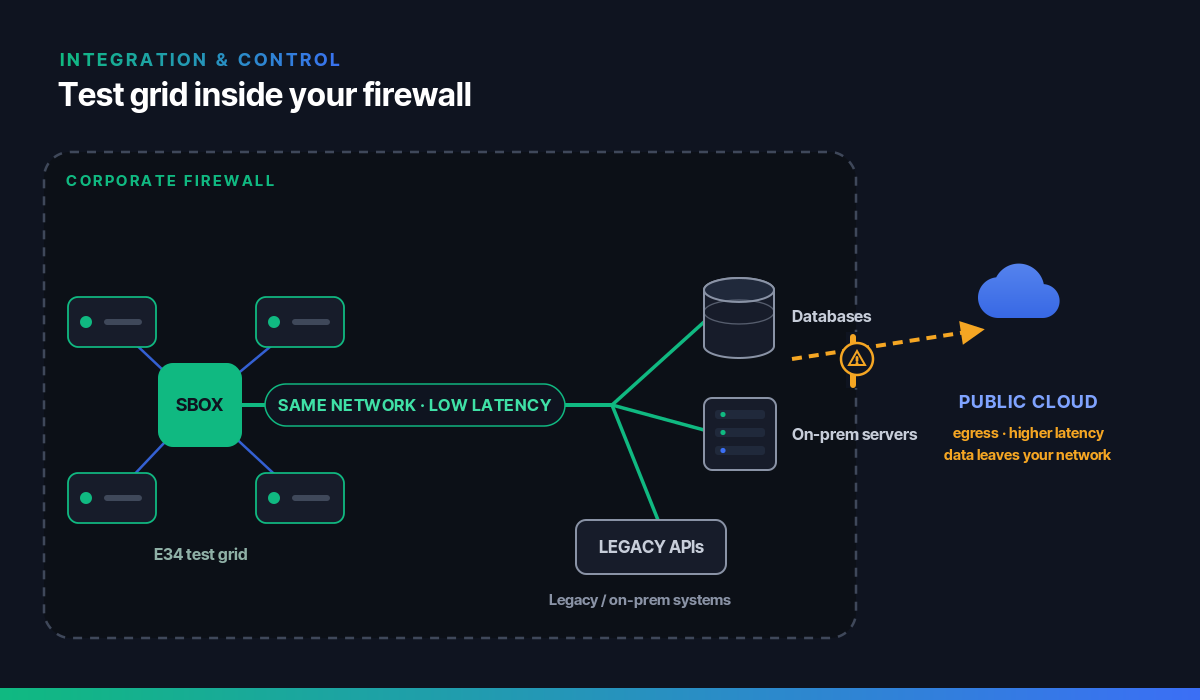
Private cloud environments allow for extreme customization of hardware and network protocols that public providers simply do not offer. For enterprises running regulated workloads, that customization is not optional. Your QA team may need a specific browser version locked to match a corporate desktop image, a particular OS kernel required by a legacy middleware component, or network protocol configurations that reflect the production environment exactly. And full control over the Selenium Grid version and node configuration means you are never forced into an upgrade cycle driven by a vendor's timeline rather than your own release calendar.
This level of control directly enables a Shift Left strategy within secure environments. When developers can trigger comprehensive integration tests — including legacy system interactions — from a local branch without leaving the private network, defects surface earlier and remediation costs drop significantly. That is a meaningful operational advantage, and it is one that shapes how engineering leadership evaluates infrastructure choices. The next section brings those choices into sharper focus.
The infrastructure decision that shapes your test automation program is not about preference — it is about fit between your regulatory environment, your pipeline demands, and the trust your developers place in every test result.
The right cloud model depends entirely on what you are testing, who owns the data, and what failure costs you.
Public cloud tends to work better for discrete, bounded use cases. Rapid prototyping, burst-load performance testing cloud scenarios, and geographic latency checks are all situations where elastic capacity and zero upfront investment make genuine sense. If you are validating a feature before it reaches a regulated environment, shared infrastructure is a reasonable starting point.
Private cloud becomes the clear choice the moment regulated data enters the picture. Finance and healthcare organizations face audit cycles, data residency mandates, and breach liability that no shared-tenancy environment can absorb without risk. Beyond compliance, 24/7 CI/CD pipelines and deep legacy system integration — the kind covered in earlier sections — demand the low-latency, deterministic performance that only dedicated infrastructure provides.
Performance consistency is a trust issue, not just a technical one. When flaky results from shared infrastructure erode developer confidence, teams stop acting on test feedback — and the entire automation investment loses value. As Perfecto and IBM research highlights, hybrid models are emerging precisely because organizations want private infrastructure for sensitive core testing while retaining public cloud elasticity at the edges.
Security is a critical differentiator for regulated industries. That reality shapes everything examined in this article — and it points directly toward what a mature, future-ready test automation strategy must look like.
If your team is now weighing a migration from a DIY Selenium grid to a private, AI-native platform, the operational playbook is here: The Hidden Costs of DIY Selenium Grids: An Enterprise Migration Playbook.
And once the grid moves behind your firewall, the AI question is not far behind. For the architecture of private LLM test authoring inside the same perimeter, see AI Test Automation Without Data Egress: How Air-Gapped LLM Test Authoring Actually Works.
Moving back behind the firewall is not a retreat — it is the mark of a testing organization that has matured past convenience and into accountability. Regulated enterprises are not abandoning cloud flexibility for its own sake; they are reclaiming control over the environments where their most sensitive test data lives and moves. That distinction matters enormously when compliance audits arrive and auditors ask exactly where your data traveled.
Data sovereignty in testing is no longer a secondary concern. It is the organizing principle behind every infrastructure decision in healthcare, finance, and defense contracting. When your Selenium Grid runs entirely within your own network, the answer to "where did this data go?" is simple, verifiable, and defensible. That clarity is worth more than any per-minute pricing discount a shared platform can offer.
SeleniumBox (SBOX) delivers precisely that assurance — a scalable, secure testing platform that runs 100% inside your private network, built by the same team that created Selenium Grid. That lineage is not a marketing footnote; it means the architecture reflects deep, firsthand knowledge of how enterprise grids actually behave under pressure. And because the private cloud model keeps resources dedicated and isolated, your test runs never share infrastructure with an unknown neighbor.
Before your next compliance audit cycle opens, evaluate whether your current testing infrastructure can answer the hard questions auditors will ask. If the answer involves uncertainty about third-party data handling, now is the right time to act.
For the practical follow-up on operationalizing this once you're behind the firewall — DORA, HIPAA, and FedRAMP audit-day artifacts, the QMO org chart, the 8-item checklist — see Centralized QA Governance for Regulated Enterprises.
Element34 SBOX runs Selenium, Playwright, and Appium behind your firewall — with AI-native authoring, self-healing, and root-cause analysis. Bring your own LLM. Keep your test data where compliance requires it.
Book a private SBOX demo → | Explore Private Cloud deployment →
Not by default. Public cloud shared tenancy cannot demonstrate the audited access controls HIPAA requires for protected health information. Healthcare enterprises typically need private cloud infrastructure to maintain HIPAA compliance across test environments.
Private cloud test infrastructure runs on dedicated single-tenant resources that may sit inside your data center or in a dedicated VPC. On-premise testing runs exclusively on hardware you own and operate. Both eliminate multi-tenant risk; private cloud adds deployment flexibility.
Yes. A modern private cloud test platform runs Selenium, Playwright, and Appium tests in parallel across dedicated browser and device pools — all behind your firewall.
Yes. Under DORA, EU financial entities must maintain audit-verifiable control over ICT testing environments. Private cloud infrastructure meets this standard because it keeps test data, sessions, and audit logs inside the customer perimeter.
Not at enterprise CI/CD volumes. For teams running 24/7 test automation, private cloud typically becomes cheaper than public cloud within 12-18 months due to eliminated egress fees, predictable per-seat licensing, and no peak-rate surcharges.