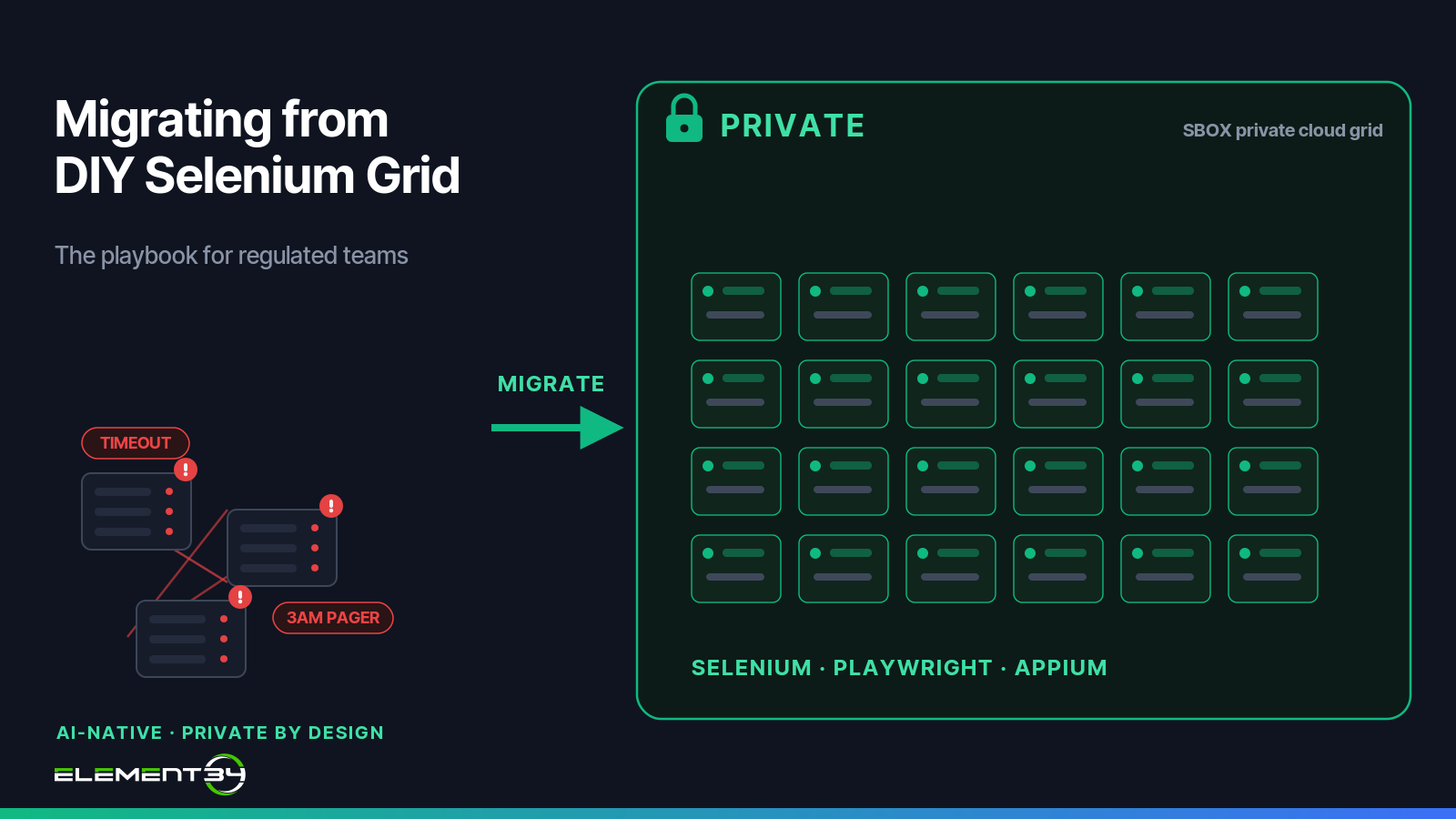
"Free" open-source infrastructure carries a hidden price tag that only becomes visible when your pipeline breaks at 3 AM.
That pager alert — the one that pulls an engineer out of sleep because the grid hub stopped responding — is not an edge case. It is the predictable outcome of a system that was never designed to absorb enterprise-scale demand without dedicated operational investment.
Maintenance debt is where the cost accumulates fastest. Browser vendors ship updates on aggressive schedules, and every Chrome release has the potential to break the driver compatibility layer your pipeline depends on. What starts as a one-hour fix turns into a recurring tax on engineering time, pulling developers away from feature work every few weeks.
Beyond version churn, DIY grids consistently hit a wall between 20 and 50 concurrent sessions. Past that threshold, resource contention spikes, queuing delays compound, and test reliability degrades in ways that are genuinely difficult to diagnose. And then there are "zombie" containers — browser processes that failed silently, consuming CPU and memory while contributing nothing to throughput. These orphaned instances corrupt pipeline reliability without triggering obvious alerts.
The cumulative weight of these problems is exactly what drives teams toward Selenium grid migration. But before evaluating any alternative, it is worth understanding why one of the most common paths — offloading execution to a public cloud provider — introduces a different category of risk entirely.
Public cloud testing platforms solve the scaling Selenium grid problem elegantly — unless your industry makes it illegal to send test data outside your network.
For regulated enterprises, the question is never "can we use public cloud?" — it is "are we allowed to?" In banking, healthcare, insurance, and government, the answer is frequently no. These industries operate under overlapping compliance mandates that treat test environments with the same seriousness as production systems. Common regulatory constraints include:
That last point deserves attention. Many public cloud testing vendors offer "secure tunnel" connectivity as a selling point, but InfoSec teams in mature organizations often view these tunnels with suspicion. A persistent outbound tunnel punches through the corporate firewall and creates a channel that is difficult to audit, monitor, or revoke quickly in a security incident.
Latency compounds the problem. Network hops to a remote cloud grid introduce measurable delays in test execution — teams migrating to cloud-hosted grids often need to increase explicit wait timeouts to compensate, a workaround that slows pipelines and obscures genuine timing-related bugs in the application under test.
The full compliance case — including audit implications for each framework — is covered in Why Regulated Enterprises Are Moving Test Automation Back Behind the Firewall. The only configuration that satisfies both security and performance requirements is keeping test execution entirely inside the corporate network. That realization is what drives regulated enterprises toward private grid platforms — and it also means the migration path requires careful technical preparation before a single node moves.
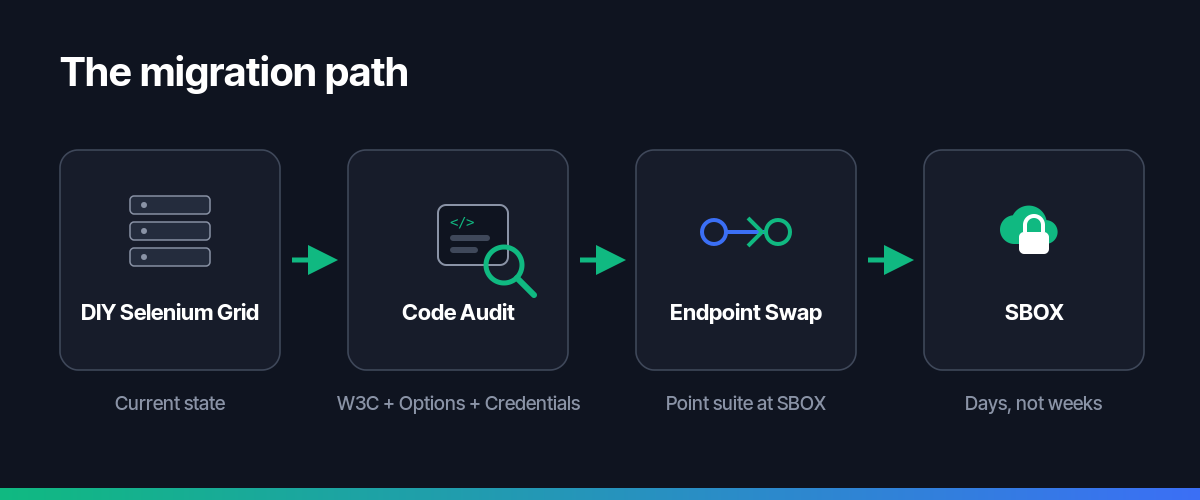
Before your team can move to an enterprise test automation platform, a targeted code audit removes the silent blockers that cause migrations to stall on day one.
Modern enterprise grids extend beyond Selenium alone. If your test suite includes Playwright or Appium tests, verify that the target platform supports parallel execution across all three frameworks. Element34 SBOX runs Selenium, Playwright, and Appium tests concurrently across the same grid — a capability most DIY Selenium-only setups cannot match without significant re-architecture.
The single most important compatibility check is protocol alignment. As the official Selenium upgrade documentation confirms, frameworks still relying on the older JSON Wire Protocol will need refactoring to conform with the W3C WebDriver standard — the baseline that all modern grid infrastructure expects.
Beyond protocol, three additional areas typically require attention:
DesiredCapabilities class has been superseded by browser-specific Options classes — ChromeOptions, FirefoxOptions, and their equivalents. Swapping these out is straightforward, but skipping this step produces unpredictable session behavior on remote nodes.LocalFileDetector class tells the WebDriver client to transfer the file to the remote node before the test executes.Running this audit before touching infrastructure tends to work better than discovering compatibility gaps mid-migration. It also surfaces the scope of refactoring work early, which matters when building a realistic timeline. Once the codebase is clean, the conversation shifts from whether migration is feasible to how session orchestration and parallelization will be handled at scale — which is exactly where the next layer of architectural decisions begins.
Eliminating Selenium grid maintenance costs is not just about cutting a line item — it fundamentally changes how engineering teams interact with their test infrastructure.
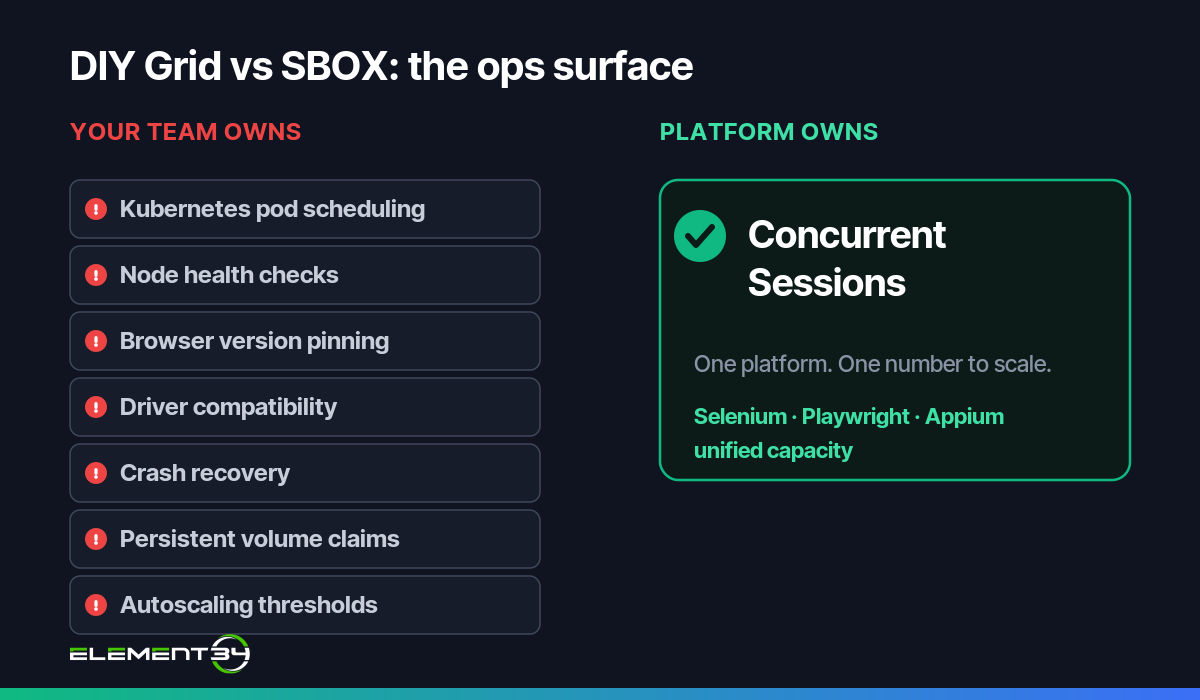
The DIY model demands constant intervention. With a self-managed grid, your team owns Kubernetes pod scheduling, node health checks, browser version pinning, and crash recovery. That operational surface area grows with every browser update and every new CI/CD pipeline added to the mix. In practice, what starts as a weekend setup becomes a part-time infrastructure role.
Enterprise platforms restructure that relationship entirely. Instead of managing nodes, you manage Concurrent Sessions — a clean, predictable resource unit that maps directly to how your CI pipelines actually behave. This abstraction removes the Kubernetes layer from your team's daily concern and replaces it with a capacity model that is far easier to reason about and budget for.
Parallelization and queuing shift from your problem to the platform's. When 80 tests fire simultaneously against 20 available slots, a well-designed enterprise platform queues the overflow gracefully rather than throwing connection errors. That queueing behavior applies across Selenium, Playwright, and Appium sessions on the same grid — teams running mixed framework test suites get unified capacity management without per-framework infrastructure duplication.
That reliability changes how confidently teams can write parallel test suites. One important caveat worth noting: because enterprise platforms charge by Concurrent Sessions, auditing your CI/CD triggers to avoid requesting 100 sessions when 20 are licensed is a practical necessity, not an afterthought.
Video capture and verbose logging also tend to become controllable knobs rather than always-on overhead. Selectively enabling artifacts only on failure trims execution time noticeably. And once your team stops firefighting infrastructure, the conversation naturally shifts toward what that recovered time is actually worth — which is exactly where the ROI picture gets interesting.
Migrating to a private cloud Selenium grid delivers measurable returns that extend well beyond eliminating a hosting bill — the real value surfaces in engineering productivity, test reliability, and global team efficiency.
Engineering time is the most underestimated line item in DIY grid TCO. When your senior engineers spend hours each week diagnosing flaky node connections, chasing driver version mismatches, or restarting zombie containers, that time disappears from feature development permanently. A common pattern is that teams only quantify the infrastructure cost itself, never the labor cost sitting beside it.
Real device coverage represents another compounding expense that self-hosted grids cannot solve cheaply. Real device coverage inside your private grid is a capability gap that DIY grids struggle to fill without significant hardware spend — emulators simply do not replicate production-level browser rendering or network behavior accurately enough for enterprise release gates.
False failures — test runs that report errors caused by infrastructure instability rather than actual code defects — erode developer trust in the entire test suite. When engineers begin ignoring red builds because they assume the grid is misbehaving again, your quality signal collapses. Managed platforms reduce this noise significantly, restoring confidence in automated feedback.
And for global, multi-region teams, centralized CI/CD infrastructure means consistent session availability regardless of where a developer commits code. Rather than maintaining regional grid deployments independently, a single managed platform distributes sessions predictably across time zones. These compounding gains — recovered hours, real device parity, reliable signal, and unified infrastructure — are what make the TCO argument land with leadership. The next section distills these threads into a concise migration summary worth sharing with your broader team.
Migrating away from a DIY Selenium Grid is not a single decision — it is a chain of interconnected technical and organizational commitments that determine whether the move actually delivers value.
DIY grids create maintenance debt that compounds silently. Every new browser version, every Jenkins upgrade, every spike in parallel test runs adds pressure to an infrastructure that was never designed to scale gracefully. In practice, teams running Selenium grid on Kubernetes discover that Helm chart tuning, pod autoscaling thresholds, and persistent volume claims require dedicated engineering attention that compounds over time — pulling focus away from test coverage and toward infrastructure firefighting.
The key migration checkpoints worth internalizing before you commit to a platform:
What determines long-term success is not just which platform you choose, but whether that platform was built with enterprise constraints — data residency, audit trails, and genuine scalability — as first-class requirements rather than afterthoughts.
On-premise Selenium grid security does not have to mean sacrificing scalability — and that trade-off is precisely the problem SeleniumBox (SBOX) was built to eliminate.
Banking, healthcare, insurance, and government organizations operate under some of the most demanding compliance and performance requirements in software testing. Both sectors need parallel execution at scale, strict audit trails, and absolute certainty that test data never leaves controlled infrastructure. What typically happens with DIY grids is that teams end up managing that tension manually — patching nodes, negotiating with security teams, and absorbing hidden costs documented throughout this article.
SeleniumBox was designed by the creators of Selenium Grid itself. That origin matters in practice. The architecture reflects first-principles knowledge of how the grid behaves under enterprise load, where configuration drift happens, and which failure modes surface at scale. Teams are not adopting a tool built around Selenium — they are adopting a platform built from it.
Beyond the grid infrastructure, SBOX includes AI-native modules that address operational pain points DIY grids cannot solve at scale:
These modules run inside your infrastructure — the same private network where your test data lives. And SBOX is bring-your-own-LLM: connect your existing OpenAI, Anthropic, Azure OpenAI subscription, or a self-hosted model. Prompts and responses move between SBOX and your AI provider only. Element34 never sees customer prompts or test data.
The result is 100% data residency without the operational burden. Test execution stays within your environment, satisfying regulators and internal security reviewers alike, while the managed layer handles provisioning, upgrades, and observability. And because the platform scales horizontally, global teams get consistent grid performance without standing up regional infrastructure independently.
The clearest next step is auditing your current grid's true cost — not just the hardware line item, but engineer hours, incident response, and compliance overhead. Once that number is visible, moving to a private, managed grid becomes a straightforward conversation with your security and finance teams.
SBOX preserves the Selenium framework compatibility of a DIY grid but eliminates the operational burden. You do not manage Kubernetes pods, driver version pinning, or crash recovery. You interact with concurrent sessions as a resource unit. And SBOX adds AI-native modules — Auto Heal, Automated RCA, Pulse Reports — that no DIY grid can replicate.
Yes. The Private Cloud deployment model supports air-gapped operation. After the initial Docker image pull, SBOX requires no external connectivity, no vendor telemetry, and no callback to Element34 infrastructure.
Yes. SBOX runs Selenium, Playwright, and Appium tests in parallel across the same grid — Chrome, Edge, Firefox, Firefox ESR, Safari on desktop, plus iOS and Android on real devices.
For test suites already using W3C WebDriver protocol and browser-specific Options classes, migration is typically a session endpoint change plus credential updates — days, not weeks. Suites still using legacy JSON Wire Protocol or DesiredCapabilities require refactoring before migration; that timeline depends on suite size.
SBOX is aligned by architecture with DORA, HIPAA, FedRAMP, PCI-DSS, and Solvency II. Test data, sessions, and audit logs stay inside the customer perimeter. The architecture enables the controls these frameworks require; individual customers still complete their own audits.