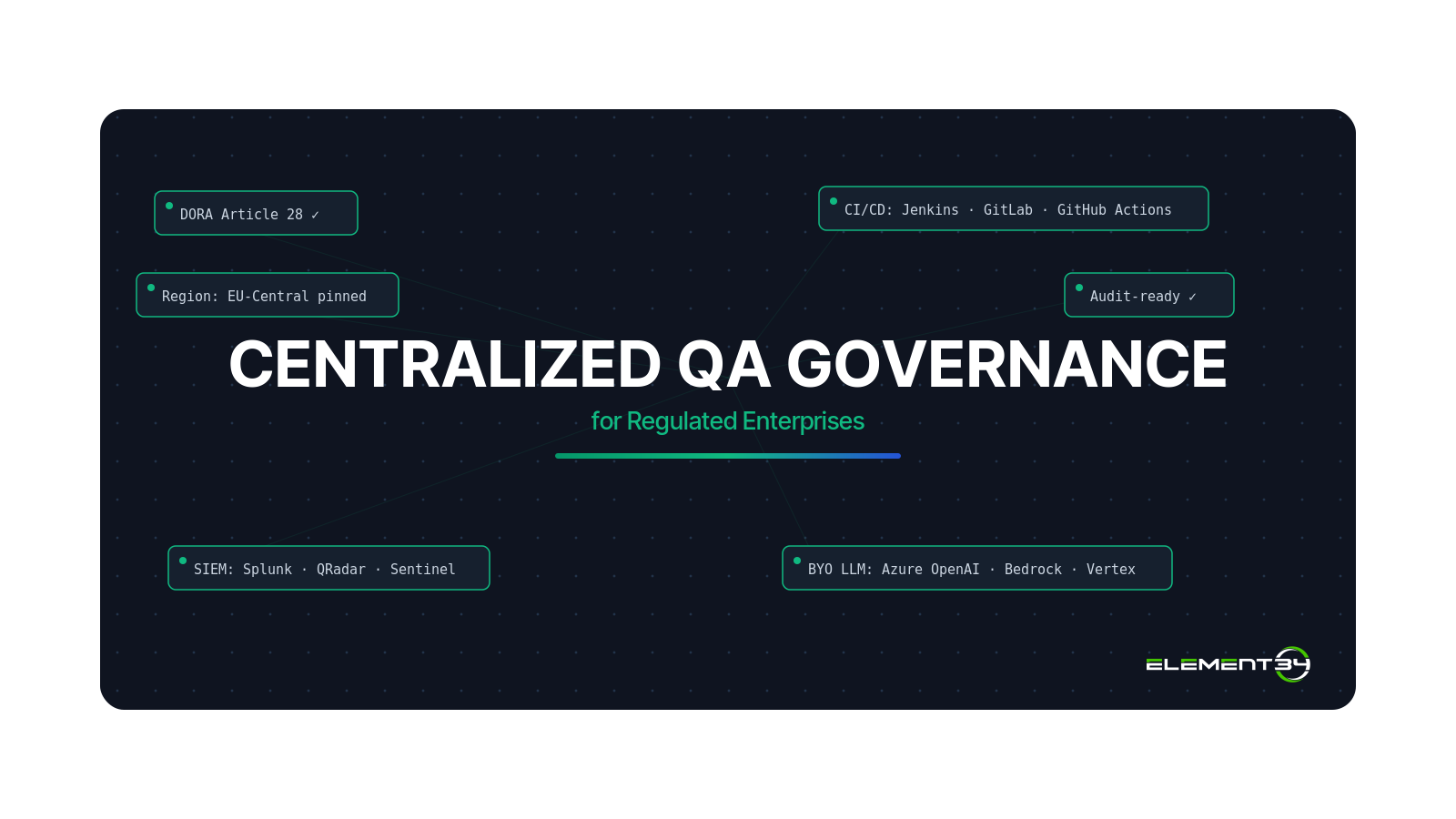
Decentralized QA is a regulatory liability for banks, hospitals, and federal agencies. This piece explains the Quality Management Office governance framework, the three-provenance observability model, and the eight-item audit-day checklist compliance officers use. Frameworks covered: DORA Article 28, HIPAA, FedRAMP, CMMC Level 2, GxP, FINRA, and FDA 21 CFR Part 11.
Fragmented QA fails a DORA or HIPAA audit because the resulting audit trail is neither complete nor reproducible on demand, which is exactly what modern regulators now require.
Regulators across healthcare (HIPAA, FDA 21 CFR Part 11, IEC 62304), financial services (DORA Article 28, FINRA, PSD2, Solvency II), federal agencies (FedRAMP, CMMC Level 2), and manufacturing (GxP) have shifted from periodic audits to continuous compliance, where evidence of control must be available at any moment. That shift punishes organizations whose QA has grown independently across business units, each with its own tools, standards, and documentation habits.
Organizational silos create the “black box” problem compliance officers now flag routinely. When teams test against different criteria and store results in incompatible systems, research on data governance and quality management shows decentralized QA leads directly to compliance gaps, black-box testing cycles, and elevated operational risk in regulated sectors.
Failed traceability, the inability to demonstrate a clean chain from requirement to test to release, can invalidate product submissions, trigger consent decrees, or generate fines that dwarf governance infrastructure costs. Organizations typically recognize the problem only after an adverse audit finding, at which point remediation is far more expensive than prevention. This pattern is exactly why regulated enterprises are moving test automation back behind the firewall.
The solution requires a structural response, one that begins with a coherent governance framework capable of speaking a unified quality language across the enterprise.
A Quality Management Office is a centralized governance body that defines, enforces, and continuously improves quality standards across the enterprise, providing the coherent structure that DORA Article 28 third-party ICT risk assessments require. See how Element34 banking test automation maps this to a live deployment.
Fragmentation risks do not resolve through better tooling alone. They require a deliberate governance structure. The QMO establishes a single authoritative body responsible for standards, evidence, and audit responses across every product line, team, and geography.
Unified Quality Language is the QMO’s foundational output. Without shared definitions of what constitutes a critical defect, a passed test, or evidence that satisfies a DORA supervisor, teams under the same regulatory framework will produce inconsistent compliance artifacts. The QMO enforces the vocabulary through documented standards and periodic audits of team-level adherence.
Strategic governance is the role the QMO assumes when it transitions QA from a bottleneck to a Center of Excellence, embedding quality decisions upstream into architecture reviews, vendor selection, and release planning.
The QMO structure typically distributes responsibility across three roles. The table below maps each role to its responsibility and the compliance value it delivers.
That traceability, from individual test cases up to specific DORA Article 28 clauses, HIPAA Security Rule controls, or FedRAMP baseline requirements, becomes the foundation for automated evidence generation.
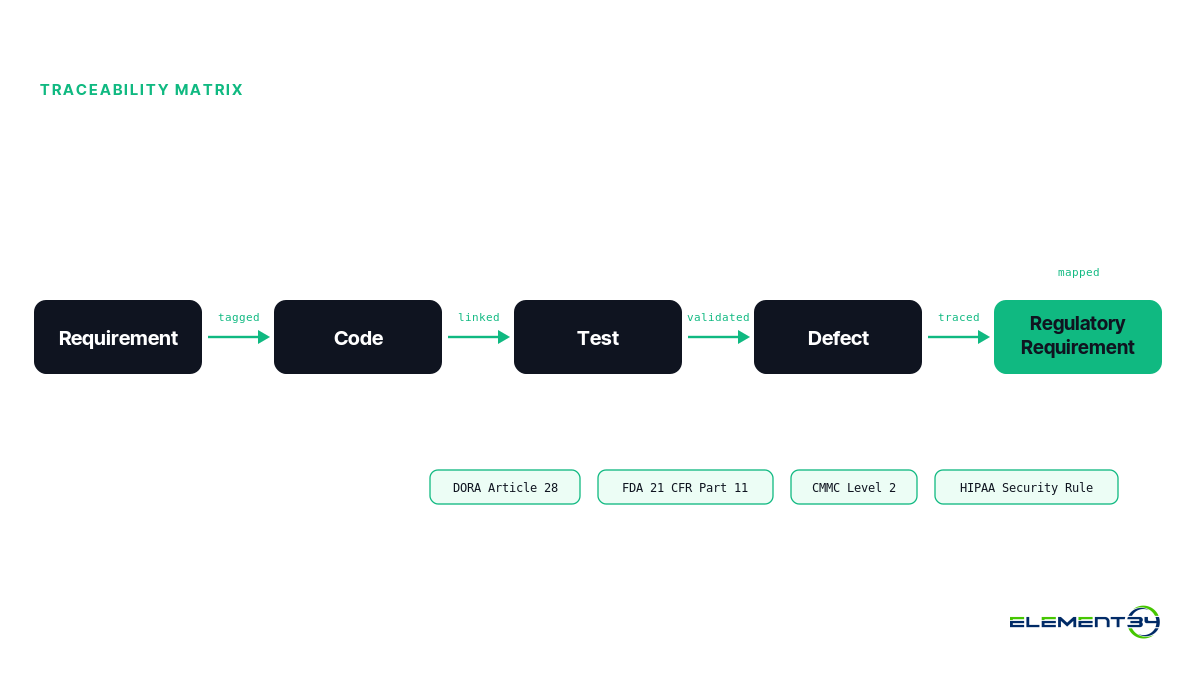
You automate the traceability matrix for FDA 21 CFR Part 11 and CMMC by tagging every artifact at the point of creation and linking forward automatically as the release progresses through the CI/CD pipeline, replacing manual spreadsheets with pipeline-native chains any auditor can query.
In slower development environments, teams could maintain traceability manually. Modern DevOps pipelines move too fast for that. Requirements change in sprint planning on Monday, code merges on Wednesday, and a release candidate is queued by Friday. By the time a compliance officer updates a spreadsheet, the traceability chain is already broken.
The full traceability chain runs across five layers: Requirement to Code to Test to Defect to Regulatory Requirement. Each artifact is tagged at creation and linked forward automatically. When a DORA supervisor asks which tests covered a specific ICT third-party risk control, or when an FDA inspector traces a control back to a validated test under 21 CFR Part 11, or when a CMMC assessor maps evidence to a Level 2 practice, the answer is generated in seconds rather than reconstructed over weeks.
Policy as Code is the most durable enforcement mechanism because it does not rely on human review. Compliance rules encoded directly into the CI/CD pipeline block non-compliant releases automatically before they reach production. A rule might specify that no change touching a regulated data field can merge unless a corresponding validated test exists and passes. This same discipline maps cleanly to CMMC Level 2 configuration management practices and to FDA 21 CFR Part 11 electronic record integrity requirements.
Blocking a release is the easy part. Knowing why a release was blocked, and proving that logic to a regulator, requires telemetry that goes well beyond pass or fail.
GxP, FINRA, and FedRAMP auditors look for three distinct provenance layers of observability signal: who ran the test with which data, which AI provider handled which prompt, and which CI runner triggered which execution against which code commit.
A pass or fail status tells a regulator what happened. Deep observability tells them why, when, by whom, and under what conditions. Modern regulatory scrutiny, whether from FDA inspectors reviewing GxP validation records, FINRA examiners tracing algorithmic trading controls, or FedRAMP 3PAOs reviewing GovCloud test execution, demands timestamps, environment metadata, dependency versions, and reconstruction of decision logic. As enterprise AI observability guidance from Liminal notes, governance-grade visibility requires comprehensive audit logging and event traceability, not just infrastructure monitoring.
Deep observability rests on three provenance layers auditors ask for separately.
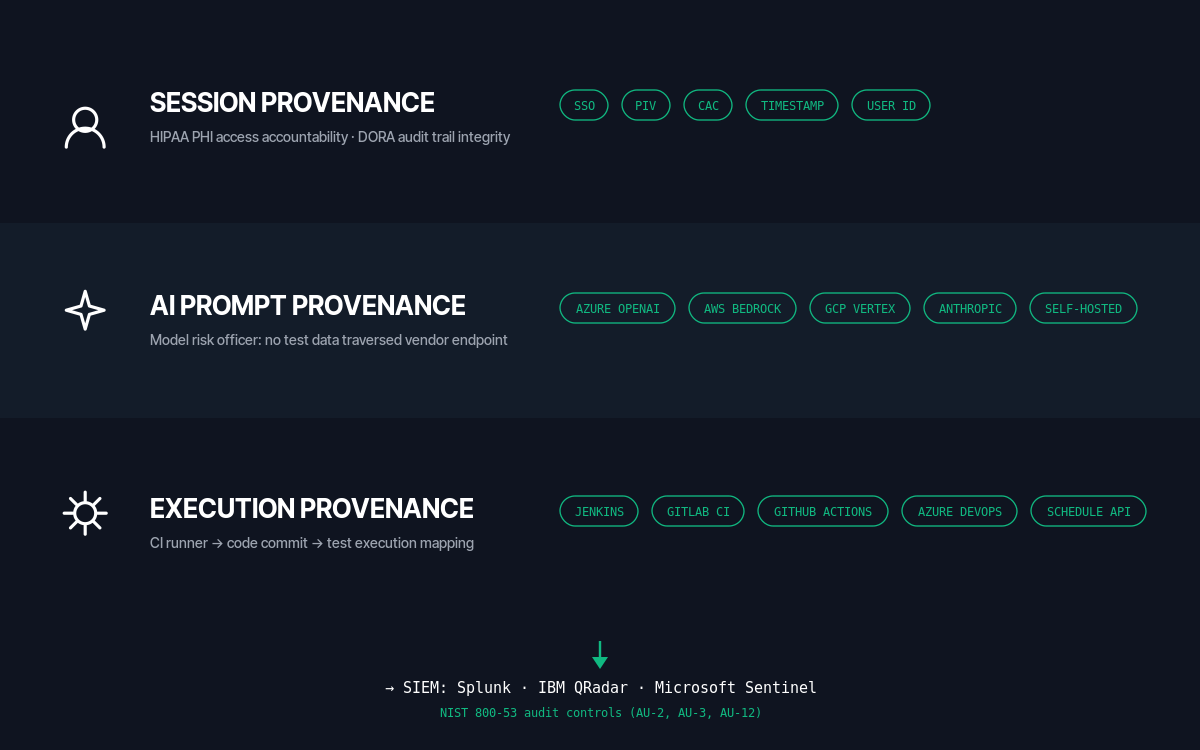
Session provenance captures which user ran which test with which data set, timestamped and attributable to a named identity through SSO, PIV, or CAC. HIPAA reviewers examine this layer to prove PHI access accountability; DORA supervisors examine it to verify audit trail integrity.
AI prompt provenance captures which large language model handled which prompt, whose API key authorized the call, and where the response landed. For enterprises using bring-your-own-LLM architectures with Azure OpenAI, AWS Bedrock, GCP Vertex, Anthropic, or self-hosted models, this layer proves to a model risk officer that no test data or PHI ever traversed a vendor-controlled endpoint. It is also the layer that satisfies AI governance reviews mandated by internal audit in Tier-1 banks.
Execution provenance ties test outcomes to specific CI runs on Jenkins, GitLab CI, GitHub Actions, or Azure DevOps, and to any CI provider integrated through a universal schedule API such as CircleCI, TeamCity, Bamboo, Bitbucket Pipelines, or custom internal CI. Change event correlation, environment snapshots, and deviation records all live here.
Session-level and execution-level audit logs should export natively to the enterprise SIEM, whether Splunk, IBM QRadar, or Microsoft Sentinel, aligned to NIST 800-53 audit and accountability controls (AU-2, AU-3, AU-12) and retention policies mapped to FINRA Rule 3110, HIPAA 164.316, or DORA Article 28 record-keeping mandates.
This depth of instrumentation raises an important question about where the telemetry lives and who controls access to it.
A private Selenium grid matters for DORA and FedRAMP governance because public multi-tenant grids move test data, session recordings, and AI prompts into vendor-controlled infrastructure, which fails DORA Article 28 third-party ICT risk assessment and FedRAMP data-egress requirements by design.
When test suites execute against a public grid, real or realistic data often travels with them. Masked datasets slip through imperfectly, environment configurations expose credentials, and PII in API responses moves outside the corporate firewall. For regulated industries, that exposure maps directly to a DORA Article 28 material finding, a FedRAMP data-egress violation, or a HIPAA breach notification trigger.
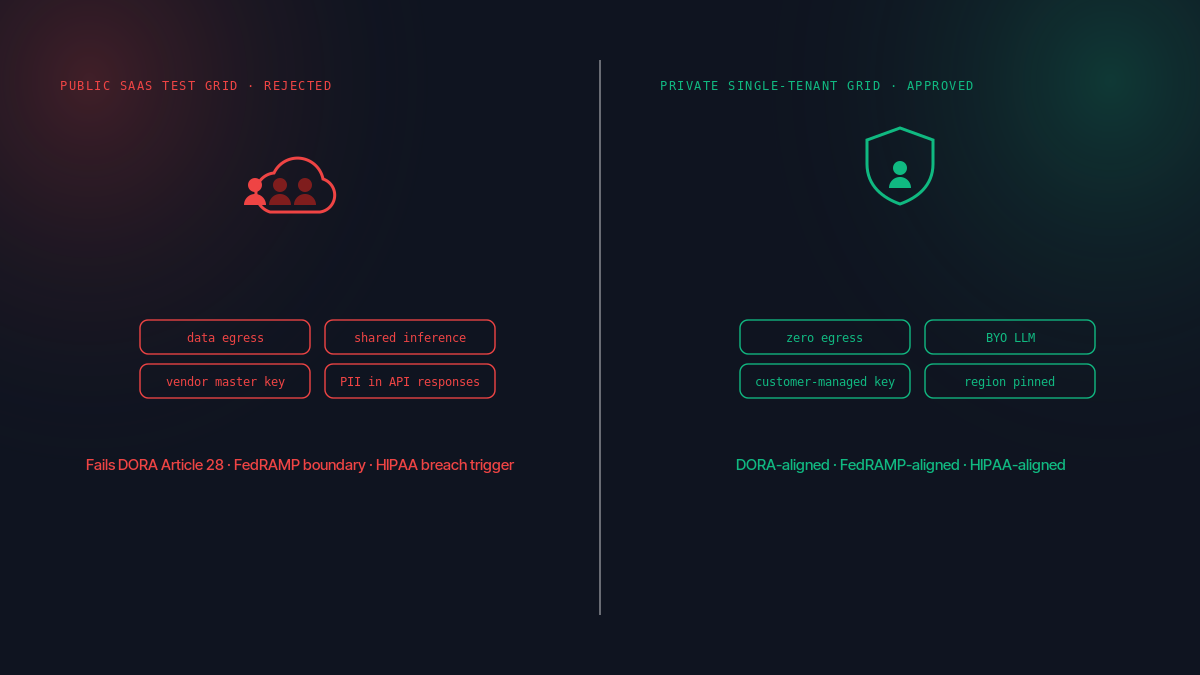
A single-tenant private grid such as Element34 SBOX runs 100 percent inside the customer perimeter. Test execution supports Selenium, Playwright, and Appium, but every browser session, mobile interaction, and AI inference call stays inside the tenancy. Data residency stops being a policy aspiration and becomes an architectural guarantee that maps to DORA regional pinning, FedRAMP boundary requirements, HIPAA data residency mandates, and GDPR Article 9 special-category health data protections.
Centralized observability only delivers full value when the infrastructure underneath is as controlled as the policies above it.
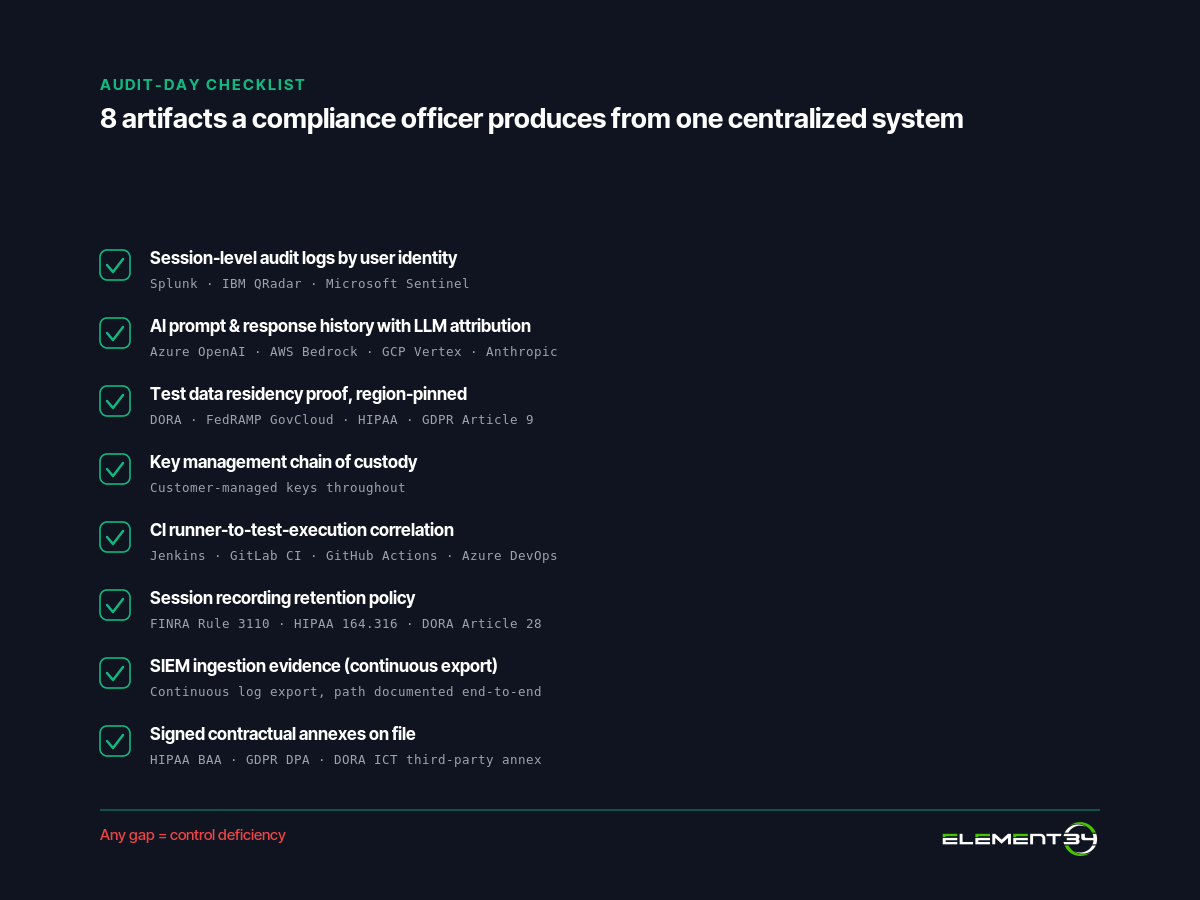
A compliance officer walking into an audit review with an internal auditor, a DORA supervisor, a FedRAMP 3PAO, or a HIPAA reviewer needs to produce eight specific artifacts from a single centralized system. Any gap becomes a control deficiency.
Centralization is not the enemy of speed. It is the prerequisite for automated compliance. On audit day, a compliance officer should be able to produce these eight artifacts from one centralized system:
Shifting quality controls left is widely reported to reduce remediation costs by roughly ten times compared to fixing issues post-release. The same discipline applied to governance means embedding these eight artifacts into the pipeline from the start, not retroactively assembling proof during an audit window.
Element34 SBOX centralizes QA governance for regulated enterprises by combining a single-tenant private grid, native SIEM export, bring-your-own-LLM inference, and a universal CI/CD schedule API into one platform that maps directly to DORA, HIPAA, FedRAMP, and CMMC audit requirements.
When test execution sprawls across public cloud environments and disconnected toolchains, audit trails fragment and the cost of every regulatory review climbs. The answer is infrastructure-level control that keeps sensitive test data within defined boundaries and under verified custody.
SBOX integrates directly with the Quality Management Office model, providing a single source of truth for test execution, results, and compliance artifacts. Every test run is traceable. Every environment is consistent. Every audit request can be answered from one centralized record rather than assembled from scattered logs.
For sector-specific implementations, see how SBOX serves banks and insurers under DORA and Solvency II, federal agencies operating in AWS GovCloud with Carahsoft procurement, and healthcare providers, payers, and MedTech vendors under HIPAA and FDA 21 CFR Part 11. For the integration architecture that ties CI/CD schedule APIs, SIEM export, and BYO LLM inference together, see the SBOX integrations reference.
Book a technical demo to see the centralized QA governance architecture in your own environment, or review the SBOX security architecture reference first.
DORA Article 28 brings test automation vendors handling production-shaped bank data into scope of the bank’s ICT third-party risk assessment. Public multi-tenant test grids fail by design. Centralized QA that runs single-tenant inside the bank perimeter with customer-managed keys and SIEM-native audit logs is DORA-aligned by architecture. See Element34 banking test automation.
Yes. A single-tenant private grid inside AWS GovCloud, Azure Government, or Google Cloud Public Sector satisfies FedRAMP-aligned architecture requirements. Test data, session recordings, and AI prompts stay inside the agency tenant. Element34 SBOX is available through the Carahsoft procurement channel. See Element34 government test automation.
A BAA covers vendor handling of PHI. When the QA platform runs single-tenant inside the covered entity’s perimeter with customer-controlled keys, the BAA scope is limited to software licensing because the vendor never handles PHI directly. See Element34 healthcare test automation.
Session-level logs by user identity, AI prompt and response history with LLM provider attribution, test data residency proof, key management chain of custody, CI runner correlation, session recording retention evidence, SIEM ingestion evidence, and signed BAA, DPA, or DORA annex documentation. All eight should be producible from one centralized system.
Monitoring produces a pass or fail signal. Observability produces the timestamped, user-attributed, environment-versioned evidence chain that reconstructs why a test passed or failed. For DORA, HIPAA, FedRAMP, and FDA 21 CFR Part 11 audits, observability is required and monitoring is not sufficient.
The most portable pattern is a universal schedule API that any CI provider can call: Jenkins, GitLab CI, GitHub Actions, Azure DevOps, CircleCI, TeamCity, Bamboo, Bitbucket Pipelines, or custom internal CI. This avoids vendor plugin lock-in. See Element34 integrations.
Yes. Bring-your-own-LLM architectures connect to Azure OpenAI, AWS Bedrock, GCP Vertex, Anthropic, or a self-hosted model. Prompts and responses move between the QA platform and the customer’s AI provider only. The QA platform vendor has no access to prompts, responses, or test data, and is not in scope of the customer’s AI governance review.