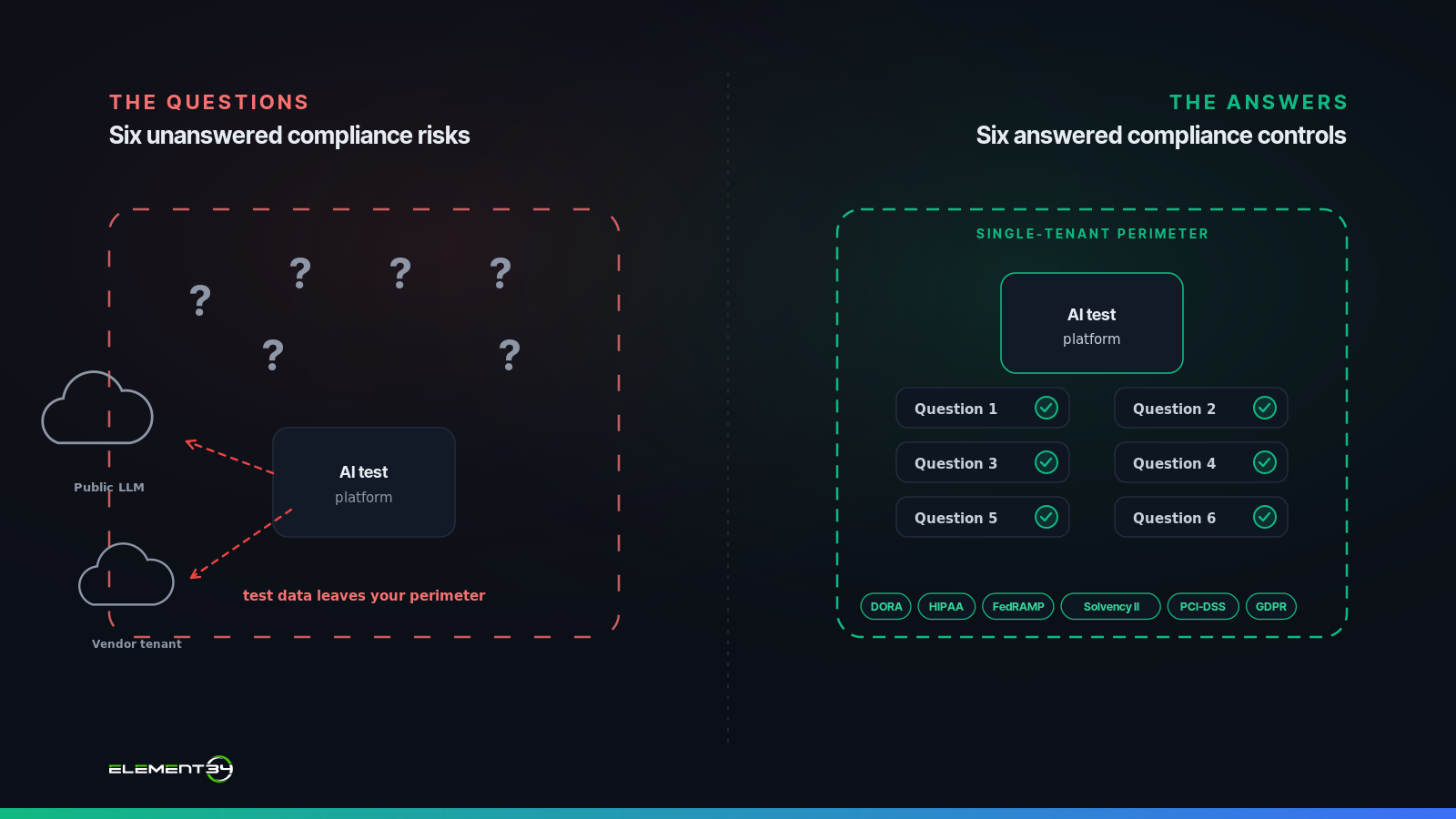
Every regulated QA leader we talk to opens the same conversation. Not "does AI work" but "will it survive an audit." We hear the same six questions from banking, insurance, healthcare, and public-sector teams, and the answers are always about architecture, not aspiration. This is the short version. For the full 56-minute walkthrough with live diagrams, watch the on-demand webinar Private by Design: AI-Powered Enterprise Test Automation.
Traditional test automation is deterministic: the same input produces the same output, every time. AI-driven test automation breaks that contract. Models make judgment calls, self-heal broken selectors, and flag anomalies without explicit rules. That variability is what compliance officers actually push back on, and it is what the frameworks below were not designed to accommodate.
The frameworks that decide these conversations, in one line: DORA in EU financial services, HIPAA in US healthcare, FedRAMP for federal workloads, Solvency II for insurance, PCI-DSS for card handling, and GDPR everywhere. Each has one shared demand: test data does not leave the perimeter.
Only if the test tool never touches the LLM API on your behalf. Public SaaS test platforms that "add AI features" typically route your test prompts, DOM captures, and session context through their vendor tenant to reach OpenAI or Anthropic. Your data now exists in three places: your app, the test vendor, and the LLM provider. Under DORA Article 28, that vendor tenant is an ICT third-party you have to register, assess, and audit.
BYO-LLM means the test platform sends prompts and responses directly between your tenant and your own AI provider or self-hosted model (vLLM, NIM, or an internal Bedrock, Vertex, or Azure OpenAI subscription). The platform vendor sees zero prompts, zero responses, zero test data. Prompts never train a shared vendor model.
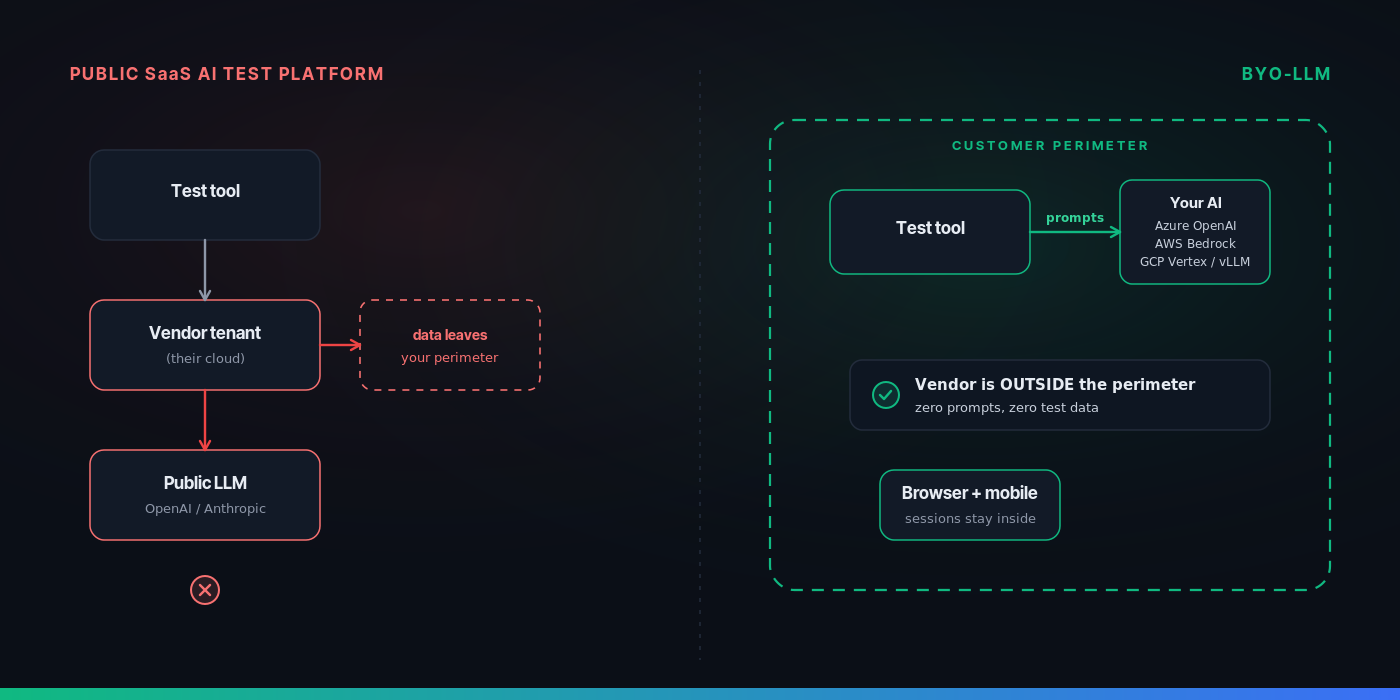
Vendor questions that surface this cleanly: Does your platform hold my LLM API keys? Where does the prompt travel between capture and inference? Do you retain generated code or session context? If any answer is "yes, briefly, on our infrastructure," it is not BYO-LLM. See our writeup on AI test automation without data egress for the full data-flow diagram.
Yes, if the platform deploys single-tenant into the region-pinned tenant, not as a shared service that federates into it. A public SaaS test grid extended "into GovCloud" often still routes control-plane traffic through commercial infrastructure, which fails the FedRAMP boundary review.
The pattern that clears the boundary: hub plus executors deployed inside AWS GovCloud (US-East, US-West), Azure Government, or Google Cloud Public Sector, with all AI inference against the same cloud's regionalized LLM services. Session recordings, generated code, and audit logs stay inside the agency tenant.
Federal procurement usually runs through Carahsoft. Element34 SBOX is available through that channel with FedRAMP-aligned architecture, single-tenant deployment, and audit logs that export natively to Splunk, IBM QRadar, or Microsoft Sentinel. Deep dive on our government test automation page.
Four checkable properties.
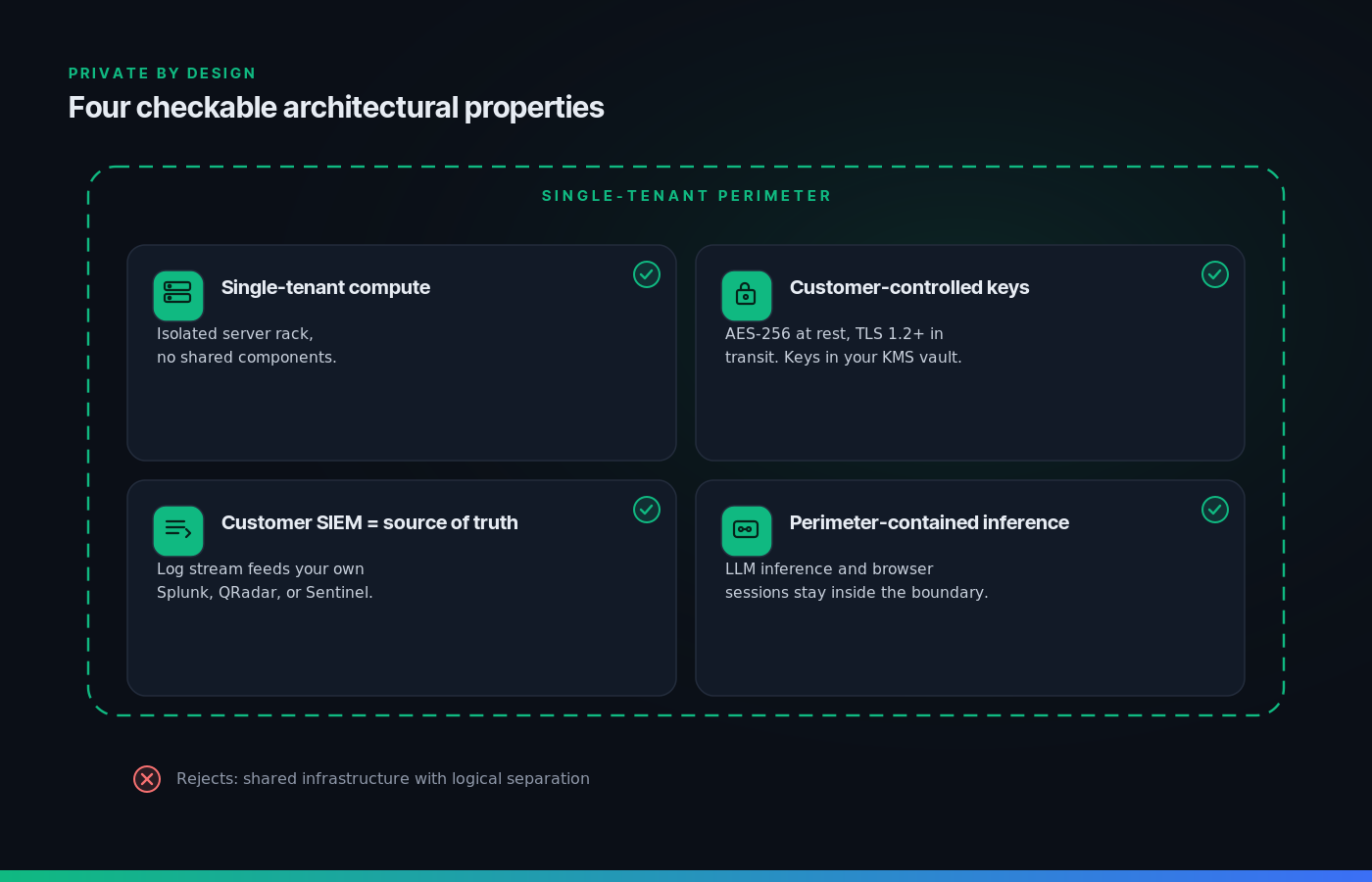
Single-tenant compute, so no other customer shares your grid, your queue, or your database. Customer-controlled keys, so encryption at rest (AES-256) uses keys you rotate in your KMS, and transit (TLS 1.2 or higher) terminates inside your perimeter. Customer SIEM as the audit source of truth, so session, user, config, and AI prompt metadata land in your Splunk, QRadar, or Sentinel with your retention policy, not the vendor's. Perimeter-contained inference, so browser sessions, mobile interactions, and AI prompts execute inside a boundary you can draw on your network diagram.
If any of the four is delivered by "shared infrastructure with logical separation," that is not private by design. That is multi-tenant SaaS with contract language.
The trade-off the industry does not talk about: single-tenant means you cannot claim vendor economies of scale for pricing. Element34's model is annual concurrency-based licensing, not per-test SaaS metering. Compliance teams find this easier to model against a DORA third-party ICT risk assessment.
See our architecture page and compliance posture for the deeper walkthrough.
Watch the webinar segment on the architecture →
The wrong answer is "we hold SOC 2 Type 2 certification" if you do not. It is also the wrong answer when the certification you hold covers the corporate SaaS, not the customer's deployment.
The right answer sounds like this: "Element34 provides the architecture that helps your team meet these frameworks: single-tenant deployment, customer-managed keys, and SIEM-native audit logs. Certification of a given deployment sits with the operating organization. We support that work with SBOM, architecture diagrams, and audit evidence rather than claiming a certification on your behalf."
This distinction matters legally. Under Solvency II Pillar 2 and HIPAA § 164.308, the covered entity or insurer holds the compliance obligation. A test vendor's SOC 2 report from three years ago does not transfer that obligation. Auditors know this. RFI language that acknowledges the boundary lands better than language that pretends to erase it.
AI can execute. It cannot attest. That is the sentence to remember when a vendor pitches you a certification as a substitute for architecture.
Auditors do not accept "the system decided." They expect a documented chain of reasoning from CI commit to AI prompt to test outcome, and they want the log to be immutable.
A stock self-managed Selenium grid gives you working test execution. What it typically lacks under audit: named-identity session provenance so every browser session ties to a real user or CI service account, AI prompt provenance so every AI-generated selector or fix has a captured prompt and model version, execution provenance so each test run links to a CI job in GitLab, GitHub Actions, Azure DevOps, or Jenkins with commit SHA and pipeline ID, and native SIEM export so this evidence lands in Splunk, IBM QRadar, or Microsoft Sentinel with your retention policy.
The scenario auditors keep asking about. A self-healing test silently swaps a CSS selector during a nightly regression on a patient-data form. No human reviewed the change. Tests keep passing. The underlying workflow no longer matches the validated process. Six months later, an internal audit flags the discrepancy. Without a timestamped record linking the original element, the detected DOM shift, the AI's replacement logic, and the prompt version behind it, that change looks unauthorized. With that record, it is a defensible, provenance-linked event.
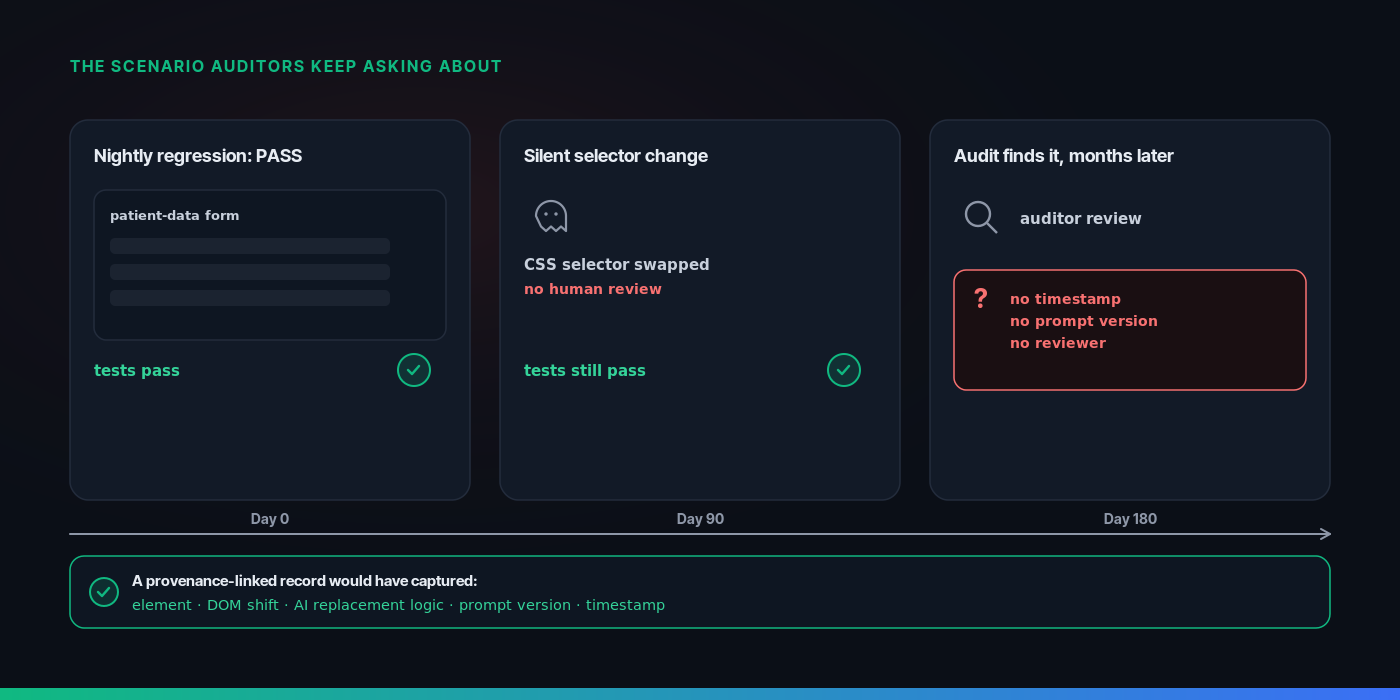
Under DORA Article 28 and the EU AI Act, this provenance is the audit evidence. Not the test results. Not the pass rate. The evidence chain that shows a human can trace any given test outcome back through the AI reasoning to the CI commit that triggered it.
Detailed treatment in our post on centralizing QA governance and observability across a regulated enterprise, and full walkthrough in the webinar.
Two to six weeks depending on model. VPC inside your existing AWS, Azure, or GCP account, typically two to three weeks. Private Cloud on-premises or Managed Private Cloud operated by Element34, four to six weeks. Rollout blockers are usually organizational (VLAN, PAM, key vault) not technical.
Licensing is annual concurrency-based, not per-test SaaS metering. Easier to model in a DORA ICT third-party register. Easier to renew without surprise burst charges. No public price sheet.
Contracts include the DPA, DORA ICT annex where applicable, HIPAA BAA for healthcare, and Solvency II outsourcing schedule. SBOM available under NDA. Deep-dive across models in private cloud vs public cloud testing for regulated enterprises.
Every one of these six questions gets an architecture-level answer in our on-demand webinar Private by Design: AI-Powered Enterprise Test Automation. Live diagrams for the BYO-LLM data flow, a GovCloud deployment map, and the exact RFI language that passes compliance review.
For QA leads, engineering directors, and compliance officers evaluating AI test automation vendors. No form gate on the intro. Enter your work email once and the recording starts.
Prefer a private conversation? Book a demo or talk to sales for a scoped walkthrough inside your own infrastructure.
One question to hold onto through every vendor conversation: can you prove what happened, why it happened, and who approved it? If the answer to any of the three is "the AI decided," you have an audit exposure, not a test result.
Does BYO-LLM keep test prompts private?
Yes when the platform sends prompts and responses directly between the customer tenant and the customer's own AI provider or self-hosted model. The platform vendor never receives prompts, responses, or test data. Prompts never train a shared vendor model.
Can AI test automation run inside AWS GovCloud or FedRAMP boundaries?
Yes when the platform deploys single-tenant inside AWS GovCloud, Azure Government, or Google Cloud Public Sector, with all inference against regionalized LLM services. Session recordings, generated code, and audit logs stay inside the agency tenant.
Does Element34 hold SOC 2, ISO 27001, HIPAA, or FedRAMP certification?
Element34 provides the architecture that helps your team meet these frameworks: single-tenant deployment, customer-managed keys, and SIEM-native audit logs. Certification of a given deployment sits with the operating organization, and we support that work rather than claiming a certification on your behalf.
What is Selenium Grid provenance for audit?
Provenance means every test run ties to a named identity, an AI prompt with model version, a CI commit, and a SIEM record. This evidence chain lets a human trace any outcome back through AI reasoning to the pipeline that triggered it.
How long does compliant SBOX deployment take?
Two to three weeks for VPC inside customer cloud. Four to six weeks for Private Cloud or Managed Private Cloud. Blockers are usually organizational (VLAN, PAM, key vault), not technical.