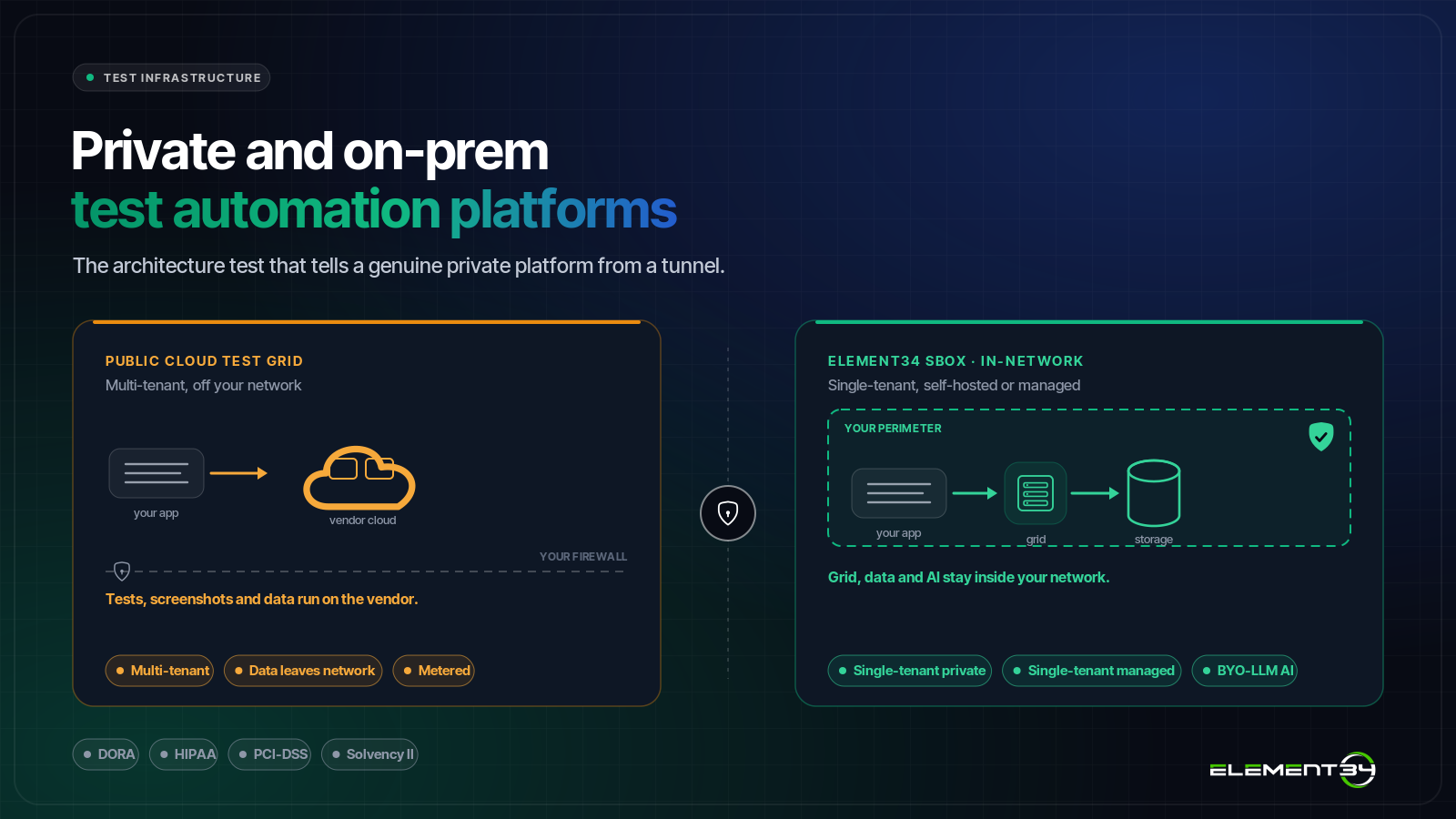
The word "private" is used loosely across this market, and the differences decide whether you pass an audit. Before comparing platforms, separate four genuinely different architectures.
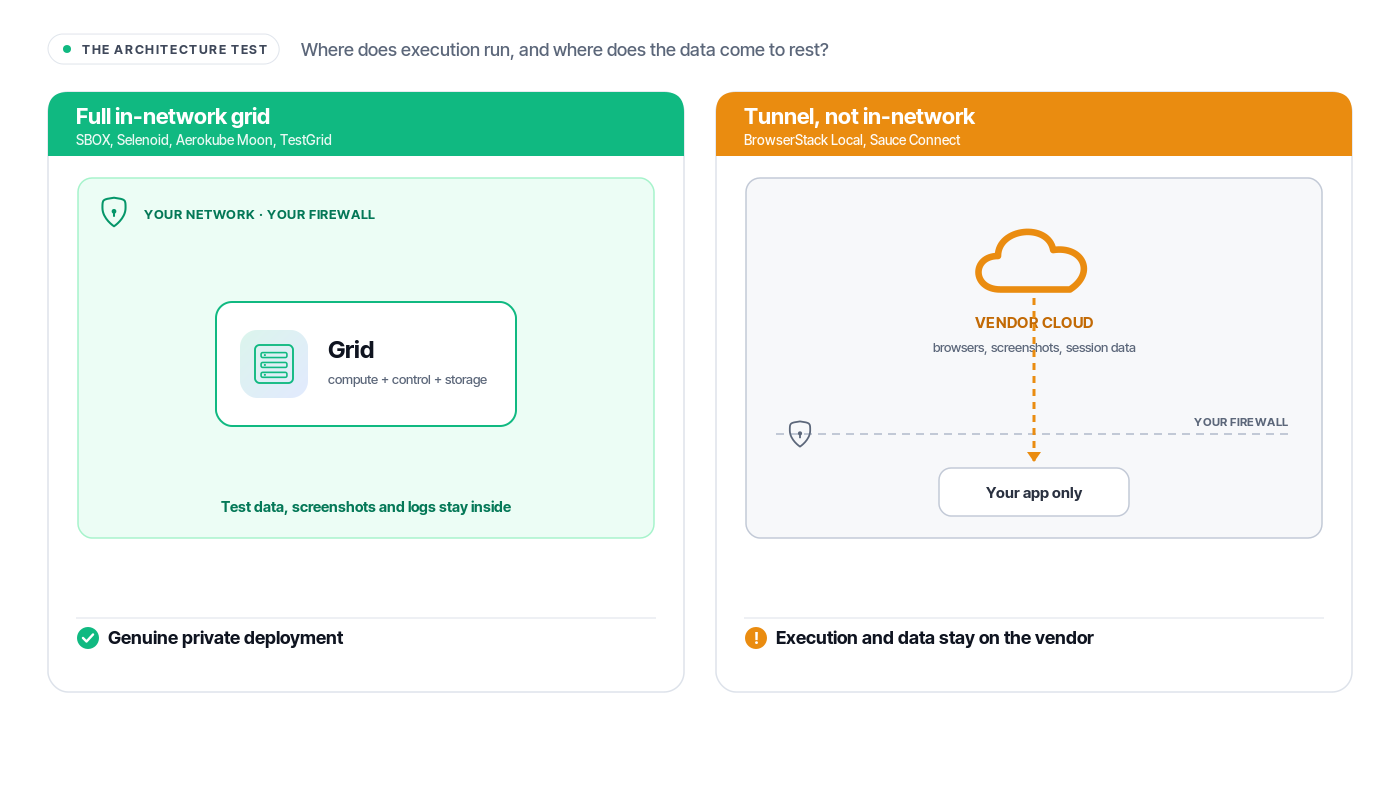
The single most common and most expensive mistake is treating a tunnel as a private deployment. A tunnel lets browsers and devices in the vendor cloud reach an application behind your firewall. That is useful, but the test execution, the screenshots and the session data still sit on the vendor's infrastructure, which is exactly what an auditor will flag. Keep this test in mind through the rest of this guide: where does execution run, and where does the data come to rest.
SBOX is a private, AI-native Selenium, Playwright and Appium grid, built by the team that created Selenium Grid. It is single-tenant by default in every deployment mode: self-hosted private cloud, inside your own VPC, or a managed private cloud that Element34 operates on dedicated single-tenant servers. There is no shared multi-tenant plan. In every mode the grid runs inside your perimeter, and after the initial container image pull there is no callback to Element34.
On the architecture test above, SBOX is a full in-network grid in all three modes, which is the point. Zero egress is the starting condition, not a setting you have to configure correctly to stay compliant. Its AI modules, authoring in Studio, Auto Heal, Automated RCA and Pulse Reports, run on your own LLM endpoint, so prompts, screenshots and test data stay inside your network. Its Real Device Cloud runs real iOS and Android inside your controlled environment, and its Lens visual testing runs on the same private grid, with checkpoints bounded by your own Kubernetes resources rather than metered per screenshot.
One specific capability is worth calling out for teams moving to locked-down browsers: SBOX is the only test platform that runs Selenium and Playwright inside Island, the enterprise browser that does not expose Selenium by default. SBOX does not claim certifications it does not hold; its architecture is designed to support deployments under DORA, HIPAA, PCI-DSS and Solvency II, with compliance remaining the customer's responsibility. A European Fortune Global 500 insurer runs more than four million Selenium and Playwright tests a year on a single-tenant Private Cloud SBOX instance inside its own premises. Full detail is on the SBOX platform page.
That is where we land. The rest of this guide is the honest part: how the other serious options measure up against the same test, so you can make the call yourself.
Every value below reflects each vendor's own public documentation, accessed 10 November 2026. We name real strengths where they exist, because an honest comparison is the only kind worth reading.
Verdict: genuine full in-network grid, open-source, no real devices. Selenoid is a free Selenium server that runs entirely on your own hardware and launches browsers as Docker containers, so control plane, compute and storage all sit on your infrastructure. It supports Selenium and WebDriver with prebuilt Chrome, Firefox and Opera images and an Android emulator image, but no iOS, no real physical devices, no Playwright or Cypress, and no AI. Aerokube itself recommends against running Selenoid inside Kubernetes and points Kubernetes users to Moon. Strong fit for engineering-led teams that want a lightweight self-operated grid and will own the maintenance.
Verdict: genuine in-network grid on your own Kubernetes, emulation only. Moon installs into your own Kubernetes or OpenShift cluster via Helm, so the application and browser pods run inside your cluster. It supports Selenium, Cypress, Playwright and Puppeteer. It offers Chromium mobile emulation only, not real devices, and has no AI. It is commercial and license-key based, capped at four parallel sessions without a key, with limited ARM64 support. Strong fit for platform teams with real Kubernetes skills that will operate the grid themselves.
Verdict: one product is a tunnel, one is a genuine in-network grid on your own cloud, with a vendor control plane. BrowserStack is one of the most mature testing clouds in the market, with one of the largest device and browser matrices available. Two offerings use "local" or "self-hosted" language and are opposite. BrowserStack Local is a tunnel: browsers and devices run in the BrowserStack cloud and only reach your app over the tunnel. BrowserStack Automate Self-Hosted is a separate product that genuinely executes the browser grid inside your own AWS, Azure or GCP account, including an existing Kubernetes cluster. Under Automate Self-Hosted the control plane stays BrowserStack's, artifact storage on a bring-your-own cluster is configured separately, real mobile devices still run on BrowserStack's hosted fleet, and the AI-agent suite runs in the vendor cloud. It supports Selenium, Playwright and Cypress. Fit for teams whose auditor requires browser compute in their own cloud tenancy but who accept a vendor-side control plane and vendor-hosted real devices. For the head-to-head, see our SBOX vs BrowserStack comparison.
Verdict: tunnel for the browser and mobile cloud; dedicated devices are still vendor-hosted. Sauce Labs is a strong, broad testing cloud, but Sauce Connect is a tunnel: tests run on Sauce infrastructure and the tunnel reaches your app. Sauce Private Devices are a dedicated real-device pool reserved for one organization, but the hardware is hosted in Sauce data centers, so it is dedicated rather than inside your network. Sauce does offer a genuinely self-hostable product for API testing in your own VPC, but that is API testing only and separate from the browser and mobile grid. It supports Selenium, Playwright, Appium and Cypress. Fit for teams that need broad coverage and dedicated devices and can accept that execution stays on Sauce infrastructure. For the head-to-head, see our SBOX vs Sauce Labs comparison.
Verdict: genuine in-network options exist at the enterprise tier. Alongside its public cloud, LambdaTest and TestMu AI document an On-Premise Selenium Grid that runs inside your firewall, and HyperExecute Private Cloud, which deploys its runner into your own cloud account and is listed on the AWS and Azure marketplaces. It also offers a Private Real Device Cloud with an on-premise variant where devices sit behind your firewall. It supports Selenium, Playwright, Appium and Cypress. The caveats: the default product is public cloud plus a tunnel, the genuine in-network options are enterprise and contract-priced, and some marketplace deployments require VPC peering to reach private apps. Fit for teams that want a familiar commercial feature set with a genuine on-prem path and are buying at the enterprise tier. For the head-to-head, see our SBOX vs TestMu AI (LambdaTest) comparison.
Verdict: genuine full in-network deployment focused on customer-hosted real devices. TestGrid's on-prem option puts real devices, browsers, the control and execution layer and results storage inside your own environment, and it offers a rack-mountable private device-lab appliance accessed over your VPN. Real iOS and Android devices sit inside your network with enterprise MDM, and it supports Appium, Selenium and Cypress. Its AI agent is described as operating within the secured lab, though that boundary is asserted at the marketing level rather than in verifiable technical documentation. Private pricing is custom, and a managed on-prem variant exists where TestGrid operates the lab, so confirm who administers the hardware if you want true self-operation. Fit for teams whose primary need is customer-hosted real mobile devices.
Verdict: a visual layer, in-network only in its On-Premise mode. Applitools is the depth leader in visual testing, but it is a visual layer that captures snapshots from tests you run elsewhere, not an execution or device cloud. It offers three modes: Enterprise Cloud (SaaS), Private Cloud or Dedicated Server (single-tenant but still inside Applitools' own cloud), and On-Premise, which installs the Eyes server and stores images inside your firewall. Only On-Premise keeps Visual AI inference in your perimeter. Its SDKs cover Selenium, Playwright, Cypress and Appium. Note that its cross-browser rendering uses a cloud Ultrafast Grid, and whether that step has an on-prem equivalent is not clearly documented. Fit for teams whose main unmet need is deep visual regression and who can run On-Premise for data control.
Verdict: self-hosted control plane and local execution, but hosted browsers stay in the cloud. Katalon Studio runs locally, Katalon Runtime Engine runs on your own machines or CI agents, and Katalon Platform On-Premises self-hosts the management and reporting plane behind your firewall. Its TestOps Private Instance, by contrast, is a single-tenant cloud managed by Katalon, not on-prem, and its hosted TestCloud browsers and devices are cloud only and unavailable in the on-prem deployment. Mobile in the self-hosted path uses Appium against devices you connect to your own machine, and reaching a private app from TestCloud uses a tunnel. Selenium and Appium are confirmed; Playwright and Cypress are not documented. Fit for teams already standardized on Katalon that want a self-hosted control plane and local execution and do not need hosted browsers.
Every value reflects each vendor's own public documentation, accessed 10 November 2026. "In your network" means execution and data sit inside your own network or cloud account, not on vendor infrastructure.
Once you have separated the genuine in-network options from the tunnels, a short, honest checklist usually settles the shortlist:
For a deeper, audit-ready version of this with the four frameworks that do not bend for vendor convenience, the Private by Design guide turns these questions into a checklist you can bring to a compliance review.
A self-hosted grid runs the browser or device execution, the control plane and the storage on infrastructure you own or control, so test data never leaves your network. A tunnel runs tests on the vendor's cloud and only opens a secure path to reach an application behind your firewall. The tests, screenshots and session data still sit on vendor infrastructure, so a tunnel is not a private deployment.
Element34 SBOX runs the full grid inside your network in every mode, including the managed option. Open-source grids like Selenoid and Aerokube Moon, customer-hosted device labs like TestGrid, and the on-premise grids from LambdaTest and TestMu AI also keep execution in your network. BrowserStack Automate Self-Hosted runs the grid in your own cloud account while keeping a vendor-side control plane. Applitools and Katalon place only one layer in your network. Tools that rely on a tunnel, such as BrowserStack Local and Sauce Connect, do not.
Yes. Element34 SBOX runs Selenium, Playwright and Appium in parallel on the same private grid. LambdaTest and TestMu AI and Sauce Labs also support all three, and Aerokube Moon covers Selenium, Playwright and others. Selenoid is Selenium only.
Some do. Element34 SBOX runs real iOS and Android inside your controlled environment, as do TestGrid and the on-premise variant of the LambdaTest and TestMu AI Private Real Device Cloud. Katalon supports bring-your-own devices through Appium on a local machine. BrowserStack and Sauce Labs real devices run on vendor-hosted fleets.
Not automatically. Many platforms run AI features in their own cloud even when execution is private. Element34 SBOX runs its AI modules on your own LLM endpoint so prompts and test data stay inside your perimeter. Applitools keeps Visual AI in your network only in its On-Premise mode. For the others, confirm where AI inference runs before assuming it stays in-network.
Element34 SBOX runs Selenium, Playwright and Appium behind your firewall, with AI-native authoring, self-healing and root-cause analysis on your own LLM. Keep your test data where compliance requires it.
Book a private SBOX demo | Explore Private Cloud deployment
Related reading: private cloud vs public cloud testing for regulated enterprises and self-hosted BrowserStack alternatives for regulated banks.